Showing posts with label Sci-Fi. Show all posts

Sunday, October 26, 2014

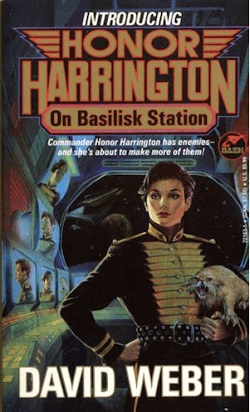
On Basilisk Station, David Weber

"HONOR HARRINGTON
Having made him look a fool, she's been exiled to Basilisk Station in disgrace and set up for ruin by a superior who hates her.
Her demoralized crew blames her for their ship's humiliating posting to an out-of-the-way picket station.
The aborigines of the system's only habitable planet are smoking homicide-inducing hallucinogens.
Parliament isn't sure it wants to keep the place; the major local industry is smuggling; the merchant cartels want her head; the star-conquering, so-called "Republic" of Haven is Up To Something; and Honor Harrington has a single, over-age light cruiser with an armament that doesn't work to police the entire star system.
But the people out to get her have made one mistake. They've made her mad."


I've long wanted to read David Weber's 'Honor Series'; it's ubiquity in some form or another in charity shops points to a wide fanbase, but until recently I never found a copy of the first in the series, 'On Basilik Station'. It was well worth the wait, and I'm very keen to read the next book.

The Baen business model is fascinating, and their commitment to freeshare books is one that's exceptional in its fairness and earned scruples. The first half dozen books in the series are currently available online to read for free, or to download to Kindle for a pittance. It allows new readers to get into the series easily, and the accessibility encourages hooked readers to continue reading by picking up a full price book.

This is an excellent idea, and for a series that is currently pushing 15 books, an easy way to entice readers into commiting to a series without breaking their bank account. It also allows for Bain to see the interest levels in their stories.

It helps that the books are fantastic, a roaring alternative to Sharpe or Hornblower set in the far future, but with a tactical and military side that does a far better job of recognizing the range and scale of space conflict than almost any other book I've read, aside from maybe Iain M Banks' Culture novels.

Honor herself is a wonderful character, a strong female protagonist with a novel back story and charisma, charm and chutzpah in spades. The villains are unsubtley written, as is the case for almost all books of this style, but that's part of the fun - and fun it is, to an almost ridiculous degree.

Also Try:
David Weber, On Basilisk Station - http://www.baenebooks.com/p-304-on-basilisk-station.aspx
Iain M. Banks, Player of Games
Orson Scott Card, Ender's Game

Wednesday, August 6, 2014

Eon, Greg Bear

"Above our planet hangs a hollow Stone, vast as the imagination of Man. The inner dimensions are at odds with the outer: there are different chambers to be breached, some even containing deserted cities. The furthest chamber contains the greatest mystery ever to confront the Stone's scientists.

But tombstone or milestone, the Stone is not an alien structure: it comes from the future of our humanity. And the war that breaks out on Earth seems to bear witness to the Stone's prowess as oracle . . ."


If Through Darkest America was unsure whether it wanted to be post-apocalyptic, civil-war epic, Western or teen drama, Eon at least has the virtue of not needing to choose what it is by being everything to all things. It's big sci-fi, hard sci-fi, in the classic vein, with a plot that is followable but not necessarily understandable for all the right reasons.

When the cold war is interrupted by the arrival of a massive meteor, orbiting the Earth, science teams are sent to investigate. At which point every expectation about what's coming next breaks down as Bear decides to just skip over the bits you assume will come next, like the initial reaction to the stone's arrival, or the consequences of a world-ending nuclear war.

This is not a story that's afraid to hit its audience over the head thematically, but it's in the actual science that things can go a bit off the deep end. When your main character is an experimental physicist so brilliant a civilisation literally centuries ahead needs her mind to advance their science you know there's not going to be too much slowing down for the kids at the back to keep up. And so it proves, as the book seeks to set up a mathematical concept allowing a TARDIS to hijack a space rock out of its dimension and back through time. And then there's a space war. Everyone in the book is 'brilliant' in their own way, which can be distracting but is probably more fair in the context of a top secret scientific exploration of future-tech and alien activity.

It makes very little sense but is terrific fun, and works as a wonderful example of truly well thought out xenofiction, up there with anything in the Ender's Game books (a series which did very well at imagining lots of very alien species).

It also has a couple of sequels which I won't be hunting out but would certainly read if I came across them.

Also Try;
Greg Bear, Darwin's Radio
Orson Scott Card, Speaker for the Dead
K. A. Applegate, The Ellimist Chronicles


Sunday, June 29, 2014

Excession, Ian M. Banks

"Two and a half millennia ago, the artifact appeared in a remote corner of space, beside a trillion-year-old dying sun from a different universe.

It was a perfect black-body sphere, and it did nothing. Then it disappeared.


Now it is back."


So, when I tell you that I've been reading this since the very start of writing this blog, I want you to understand that I mean that this is a book I have been reading, off and on, for nearly 18 months. It's not overly long, and it's certainly not a bad book, by any means. But it is dense. It's a book with heft, and weight, and it's written in a way that can best be described as unfriendly, especially in terms of ship to ship dialogue, which is largely impersonal and  punctuation free.

This main mind-to-mind conversations which make up so much of the plot drive and significant portions of each section are, it has to be said, confusing, in the same way that half an IM, or an email chain is unlikely to be a great way to understand geopolitics.

With multiple narrative strands taking place at the same time, and various different races and beings involved, it takes a while for anything like a coherent plot to kick in. I actually finished the second half in one sitting, so there's stuff to be waiting for, and once the various strands coalesce it quickly engages, but it can be a slog at first.

I've read a few of the Culture novels that Banks has written and this isn't the best for new reader's although it's certainly got enough there that if you're already a fan you'll enjoy it. Compared to Player of Games it's dry, but it meets the basic requirement of great sci-fi that it's utterly alien - whether in the world of the Affront, or glanding, or drones., or the Excession itself.

Also Try:
Player of Games, Iain M Banks
The Wasp Factory, Ian Banks
Shadow of the Empire, Timothy Zahn


Monday, March 3, 2014

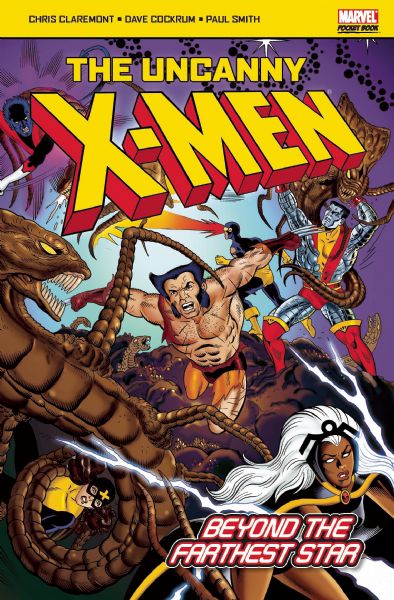
Uncanny X-Men; Beyond The Farthest Star, Chris Claremont

"The X-Men are a million miles from Earth, at the mercy of a rcae if deadly creatures known as the Brood. Infected with parasitic larvae, the mutant team must find a way to free themselves from the alien's insectoid clutches before they are transformed into new Brood warriors. An epic battle ensues as the X-Men struggle to stop their foes, whilst desperately fighting to keep control of their minds and bodies. Returning to earth for a final showdown the group must then confront one of their strongest members ho hass been infected with the embryo of a new Brood Queen. Get ready fro some classic X-action at its very best."


This is the bit where I geek out about just how strong this run on the X-Men is and everyone gets bored silly because this is, what, the third time now? The fourth? Who cares! This is magnificent. Claremont's world building is ridiculously vast, and it shows here where the conflict ranges from space battles, war on alien worlds, to internal struggles for the control of self.

Even the most ridiculous stuff (an over-reliance on cloning and magical-healing is already beginning to creep in) is counterbalanced by a rich imaginative seam of wonder, from the Brood's space-whale hunts to the idea of Lockheed.

The brood are a weird mix of blatant 'Alien' rip-offs and super creepy 'Invasion of the Body Snatchers' by way of hosting, and their lack of success is a hindrance to what is supposed to be the greatest threat to life in the galaxy.

This isn't the best in the series, by this point Claremont has passed most of the real big moments, like 'the Dark Phoenix Saga' and 'God Loves, Man Kills', and is surfing to a close. It's for completists only, I guess, but really, if this doesn't make you happy, nothing will.


You said it Kitty.

Also Try:
Chris Claremont, Uncanny X-Men: The Dark Phoenix Saga
Brian Michael Bendis, All New X-Men
Joss Whedon, Astonishing X-Men: Gifted

Also Try -Professor Xavier is a JERK edition:
Ed Brubaker, Deadly Genesis
Joss Whedon, Astonishing X-Men: Dangerous
Various, Avengers vs X-Men


Saturday, January 4, 2014

BZRK, Michael Grant

"These are no ordinary soldiers. This is no ordinary war. Welcome to the nano, where the only battle is for sanity. Losing is not an option when a world of madness is at stake. Time is running out for the good guys. But what happens when you don’t know who the good guys really are?

It’s BZRK. Noah and Sadie: newly initiated to an underground cell so covert that they don’t even know each other’s names. Here they will learn what it means to fight on a nano level. Soon they will become the deadliest warriors the world has ever seen. Vincent: feels nothing, cares for no one; fighting his own personal battle with Bug Man, the greatest nano warrior alive.  The Armstrong Twins: wealthy, privileged, fanatical.

Are they the saviours of mankind or authors of the darkest conspiracy the world has ever seen? The nano is uncharted territory. A terrifying world of discovery. And everything is to play for..."


To be honest, it has been so long since I read this that I don't fully remember all of it.

But here's what I have got. BZRK is your standard everyday tale of people who control nanotech to 'hack' the minds of others, carrying out personality (and policy) adjustments as well as assassinations in order to take control of the world. Battles are carried out, by and large, by teens controlling nanotech to take over the world.

So, so, wonderful.

Not to mention the fact that this is written by one half of the pair behind Animorphs. Alongside his wife, K. A. Applegate, Grant wrote my favourite series of all time, a series notable for its brutal realism about conflict, it's willingness to put teenage protagonists in mortal peril and actually follow through on that. All in all, a series in which a global conflict over the literal minds of the leaders of the free world isn't necessarily going to go well.

It's a cracking read, in the vein of the dystopian fiction that so much of teenage fare has become, with a more technological side which is bound to appeal to most teens. Well worth a read, in other words.

Also Try:
K. A. Applegate, Animoprhs
Michael Grant, Gone
Patrick Ness, The Knife of Never Letting Go
Suzanne Collins, The Hunger Games

Zoo, James Patterson and Michael Ledwidge

"All over the world, brutal animal attacks are crippling entire cities. Jackson Oz, a young biologist, watches the escalating events with an increasing sense of dread. When he witnesses a coordinated lion ambush in Africa, the enormity of the impending violence becomes terrifyingly clear.

With the help of ecologist Chloe Tousignant, Oz races to warn world leaders before it's too late. The attacks are growing in ferocity, cunning, and planning, and soon there will be no place left for humans to hide."


I am going to differ from probably everyone else on this book, because whilst the world seemed to hate it, I thought it was wonderful. Now, part of that may be down to the fact that the story (animals turn on humanity, go on the rampage) is exactly the kind of thing I enjoy most, or it may be down to the fact that the writers clearly are enjoying themselves way too much to care about things like facts, science or consistency.

And Boy, do they not care. Going on the basis that pheromones are things that exist, the book posits that a new pheromone could change the behaviour of every single male animal worldwide, causing them to attack humans. In packs. The real victim isn't humanity though, it's continuity, as the authors introduce important plot lines (like only male animals attack people) having forgotten that the very first attack they describe is from a lioness. And when characters disappear halfway through a chapter and never reappear again. This is all pretty normal.

But there's still a real joy to it all, whether descriptions of massive dog packs occupying major citites, or descriptions of special forces units against bears. Even when it doesn't make sense (which is every few pages), or when the science is bad (I mean, really bad - like Michael Crichton bad) it's carried along by the fact that another idea will be introduced by the next chapter and everyone will forget exactly what the problem was.

Also, the REAL villains are entitled rich people, and I think we can all get on board with that.

Also Try:
James Patterson, Maximum Ride
Michael Crichton, Next, Congo


Friday, December 6, 2013

Tactics of Mistake, Gordon R. Dickson

"It's obvious that Cletus Graeme--limping, mild-mannered scholarly--doesn't belong on a battling field, but instead at a desk working on his fourth book on battle strategy and tactics. But Bakhalla has more battlefields than libraries, and Graeme sees his small force of Dorsai--soldiers of fortune--as the perfect opportunity to test his theories. But if his theories or his belief in the Dorsai lead him astray, he's a dead man."


I have no idea why this isn't up yet. I read it months ago (in August), so it's just general laziness at this point.

Basically, this book is great, and you should read it. You can do that here: http://library.worldtracker.org/English%20Literature/D/Dickson,%20Gordon/Gordon%20R.%20Dickson%20-%20Childe%20Cycle%2004%20-%20Tactics%20Of%20Mistake.pdf

Also Try:
Robert Heinlen, Starship Troopers
Joe Haldeman, The Forever War


Wednesday, September 11, 2013

Animorphs; The Stranger, K A Applegate

"The fight for the planet continues in this gripping installment -- and the Animorphs must make an exacting choice.

The last time Rachel and her friends entered the giant Yeerk pool beneath their town things went very bad. This time they plan to be careful, and sneak in as roaches, just to spy.

Once they're inside, though, the team gets caught. But right as things are looking their most dire, everything stops. Everything.

Then Rachel and the Animorphs hear a voice. It belongs to a very old, very powerful being, and it says it can save them. But if it does, the Earth will be defenseless."


The Stranger is the seventh Animorphs book, and as I've mentioned before, as a kid I was a little bit obsessed with this series. So when I saw a copy of this book (one of my favourites) for sale at a library clearance I picked it up for JJ's brother. It's actually an updated version of the book I read, re-released last year as part of an unsuccessful relaunch of the line.

The Stranger is Rachael centred and has a couple of plot threads. Kicking off with the discovery of a new entrance to the Yeerk Pool, and the Animorph's decision to infiltrate it with the intention of discovering the whereabouts of the Yeerk's Kandrona (the replica sun that they feed from). Whilst there they encounter the Ellimist (essentially an all powerful alien God) and get given the opportunity to decide the fate of humanity.

The B plot is Rachael being given an out; a chance to leave behind her life as an Animorph and relocate to a different state with her Dad.

The plot then is all about choices, Rachael is given the chance to end her involvement in the war by both her father and the Ellimist, and her personal struggle, as well as the decisions of the Animorphs as a whole are the main focus of the book.

It's a theme that comes up a lot in the books; more notably with Cassie and Ax who both face difficulties in justifying their role against their morality (Cassie) or duty (Ax). But for a series where the decision to fight and keep fighting despite all the horrors they have experienced was notably quick, it's nice to see the ramifications of these choices.

Rachael can sometimes be a very one note character in the books that don't focus on her, but she tends to be far more nuanced in her own stories. Between this and the David arc she shows far more compassion and fear than is normally the case, even going as far as to admit to it to the rest of the Animorphs.

The key thing here is that the heroes are given an explicit opportunity to choose their destiny. The heroes choice is a common trope in fiction, emphasising that these individuals knowingly give up on the things that would make them happy for the greater good (think Bruce Wayne sacrificing his reputation to maintain the Batman secret, or Spider-Mans 'with great power must also come great responsibility').

The Ellimist gives the series a chance to explore exactly what it means for these teens to be facing up to a potential lifetime of war, it's the first time they question what the future will look like should the war drag on and on.

The conversation between Rachael and Tobias represents an acceptance that their life can't be normal again;Rachael's decision to stay with the Animorphs and not leave foreshadows the fact that, (spoiler alert), she won't make it through this war. Her chance to get out rejected she will be in it to the end, and won't get to live beyond it. The tragedy is that here is the last point at which she could conceivably have escaped from the path laid out for her - rejecting the warrior she is becoming and returning to normality with her Dad.

By contrast the Ellimist presents a different choice; not a return to the status quo and abandoning the mission, but recognition that their cause it lost and choosing to save those they care about. Abandoning the war for Earth to save their families is a harder choice to make. Unusually, despite initial resistance they eventually make the decisions to do so. The fact that the Ellimist is playing a different game altogether is irrelevant: this is a book in which the heroes do come to the conclusion that abandoning earth to an almost certainly inevitable conquest by the Yeerk's is the best option. It says something about the stakes of the series that this decision is presented as almost certainly the best one; saving a few families and the species from extinction is better than allowing the entire population to succumb to enslavement. 

It absolutely blew my mind as a kid that just a few books into such an epic mega-series the heroes are so shell-shocked and traumatised that giving up and letting the bad guys win to save a few dozen people is not only considered a valid option, but actually gets chosen as the strategy.

There are some parts where it's clear that this is one of the earlier books, and the rules haven't quite been solidified yet; during the escape from the Yeerk Pool the Animorphs demorph to human to avoid being eaten by a Taxxon, something which is unlikely to happen in later books where the paranoia about being discovered to be humans has really crept in. Rachael complaining that a controller pushed her over is especially disconcerting; it would be hard for anyone to mistake a human girl for an andalite,    so if he's knocking her over you would assume he had realised that the guerrilla force the Yeerk's were hunting wasn't just comprised of blue alien centaurs with deadly blade tails. Clearly observational sloll isn't something that Visser 3 prizes.

We do get some great action sequences in the book that made it stand out for me when younger though; the inevitably future scene of Yeerk victory with dead bodies in schools and burnt out cars was one of my first post-apocalyptic scenes. Hands down the highlight however has to be Marco punching a security guard in the face through a reinforced window whilst in gorilla morph. It's up there with his driving the truck as a gorilla (in Megamorphs 1?) as a highlight for the character.

This is a pretty important book in the series introducing the Ellimist, Rachael's Grizzly morph and fleshing out the character so often written off as a gung-ho blood knight. More tha that though it's one of the most entertaining, and features some great moments and character development for almost everyone.

Also Try;
K A Applegate, Animorphs - http://animorphsforum.com/ebooks/
Michael Grant, Gone
R L Stine, Goosebumps
Kate Thompson, Switchers Trilogy
Monday, August 26, 2013

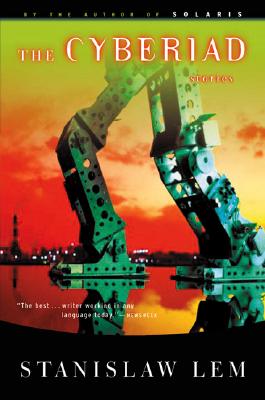
The Cyberiad, Stanislaw Lem

"Trurl and Klapaucius are the archrival constructor robots, who, ransacking myth, technology and the secrets of cybernetic generation, race to create an invention even more improbable than the last."


The Cyberiad is a collection of translated short stories from Russian Sci-Fi master Stanislaw Lem, who's probably most famous for Solaris. It follows the tales (and tales within tales) of the inventor Trurl and his misadventures within the application of his craft.

Featuring everything from the invention of a beast that can defy death for a hunting party, to a storytelling machine telling stories of Trurl and the stories he knows. There's a sense of playful inventiveness on display which is wonderfully enjoyable. None of the stories outstay their welcome, at around 20 pages each they're very short indeed. Even the longest of them involves the sleight of hand trick of building stories into further stories, a trick that Lem adores.

There's a sheer joyfulness to the world building on display, a love of language and wordplay that means that every story features intricate puns and the vocal equivalent of sight gags. To say these are great stories undermines them, they show more regard for the subtleties and depth of English than most writers manage. That this is a translated work speaks to the power of the writing; I don't know quite how much of the original text survived here, but there are enough rhymes, half rhymes and flights of surreal connections to impress.

The person who lent this to me described it as a Polish Douglas Adams. That's a perfect comparison, and frankly, when that's the person that springs to mind, you're in a good place.

Also Try:
Sergei Lukyanko, Night Watch
Douglas Adams, Hitchikers Guide to the Galaxy
Terry Pratchett, The Bromelliad Trilogy

Sunday, July 7, 2013

After America, John Birmingham

"March 14, 2003, was the day the world changed forever. A wave of energy slammed into North America and devastated the continent. The U.S. military, poised to invade Baghdad, was left without a commander in chief. Global order spiraled into chaos. Now, three years later, a skeleton U.S. government headquartered in Seattle directs the reconstruction of an entire nation—and the battle for New York City has begun."


After America is one of the most ridiculous books I have ever read, and bearing in mind that I've just posted a review of a comic that features a superhero who replaces his head with that of a ghost cow, after an undead boxer smashes his to smithereens, that is saying quite a bit.

This is the second in a series called 'The Disappeared', the plot of which is that in the run up to the Iraq war, with most of the American military about to step into a war in the Middle East, an unexplained wave of energy hits America and reduces its population to a few million. In the last book the fallout from the near total destruction of America was the near economic destruction of the world, and a pre-emptive nuclear attack by Israel on every neighbouring nation.

Having set up a new democratic Government, and prevented secessionist Texans from declaring military rule, the new President is having a hard time, due to the fact that New York has been occupied by an entire terrorist force.

Focusing on the battle to retake the city, as well as the struggles for various characters in Europe and southern America, it basically becomes a lovingly detailed book of military hardware. Much like Birmingham's other series, Weapons of Choice, this is a book that loves to go overboard on the intricacies of weaponry. What it lacks in sense, or explanations, it more than makes up for in embellished characterisation of the military.

It's a great book, don't get me wrong, in the classic mold of an airport page turner. It's not smart, it's not clever, and it's rarely all that well written. Above all, it's not good Sci-Fi. Not since 1632 decided it could just dump a modern town into history because 'aliens' has a major plot point been quite so sketchily planned. The wave is a catalyst, but it isn't ever explained. There's no attempt to analyse it. Like King's 'Under the Dome' it's just something that happens to start the plot. Reactions to it vary, but all accept it and move on.

Everything that comes after is tinged with the sense of that; people accept things and move on. People do things that don't make sense, and it's chalked up to the wave. It's bad sci-fi, and it's a shame that it's unexplored (and unexplained). At least in Weapons of Choice Birmingham attempted to rationalise an explanation.

It shouldn't bug me in a book about the invasion of New York by the US army to fight the evil forces of Islam, but it does. It's not helped by the portrayal of anyone outside of America as either evil (and Muslim) or cold and aloof (and English). These are the defaults of outside America. Not all Americans are good, but all non-Americans are pretty bad. And that's a pretty problematic world when America is quite so reduced in status and size.

Also Try:
John Birmingham, Weapons of Choise
Eric Flint, 1632
Brian Wood, DMZ
Brian K Vaughan, Y: The Last Man

Saturday, June 1, 2013

Transmetropolitan: Lust for Life, Warren Ellis

"Outlaw journalist Spider Jerusalem attacks the injustices of his surreal 21st Century through black humor as an investigative reporter for the newspaper The Word in this critically-acclaimed graphic novel series written by comics' superstar Warren Ellis, the co-creator of PLANETARY and THE AUTHORITY.

In this volume, Jerusalem targets three of society's most worshipped and warped pillars: politics, religion, and television. When Spider tries to shed light on the atrocities of these institutions, he finds himself fleeing a group of hitmen/kidnappers in possession of his ex-wife's frozen head, a distorted creature alleging to be his son, and a vicious talking police dog."


I love Transmetropolitan with all my heart, because it's an incredible example of how far you can push mainstream comics. Much like Preacher, which shows how adult a comic for mature readers can be, without ever feeling too grown-up, Transmetropolitan is an absolutely wonderful idea taking storytelling and the medium to it's extremes.

An epic sci-fi tale, told through the eyes of Gonzo journalist Spider Jerusalem (basically future Hunter S. Thompson) as he navigates The City after five years absence. An excuse to explore future-tech, concepts as varied as pornography, advertising and religion, and whatever else seemed good that week, it eventually morphs into a scathing indictment of politics, politicians and the media in the form of the election and presidency of a man known only as the smiler.

It's hard to quantify quite why it's so good. In a lot of ways I think it simply keys into a few things I love; politics, journalism, sci-fi and comics. But beyond that it's got a rich sense of imagination - the varying issues of this collection look at people self-evolving into gaseous bodies, the psychological impact of a radically different future on those coming out of cryogenic freezing, public preserves of ancient culture which include all the accurate diseases and war of the historical context. It's stuff that's remarkably prescient - not to say that vaporous upgrades or cultural reserves are imminent, but they feed off contemporary questions and concerns in an exciting and interesting way.

Whilst this isn't anything like as good as it gets, and it's certainly worth starting at volume 1 to get the fuller picture of The City and Spider's life there, this is an excellent book and one that anyone interested in comics should make time to read.

Also Try:
Warren Ellis, The Authority
Warren Ellis, Global Frequency
Warren Ellis, Thunderbolts

Monday, March 18, 2013

Mars Attacks!, The Topps Company

Mars Attacks is a series of science fiction trading cards produced by Topps in 1962, depicting the gruesome invasion of Earth by Martians. The story unfolds over the course of the 55 card series, showing futuristic battle scenes with Martians, and their cruel, often bizarre methods of attack and torture. The series culminates with a human insurrection and the destruction of Mars. The short lived series retained it's devoted following and quickly became a collectors item and remains hugely popular and influential today. Tim Burton's 1996 movie adaptation of the story brought Mars Attacks back to the forefront of pop culture and the upcoming 50th anniversary in 2012 will do the same, introducing the story to a new generation of fans. Includes rare and never before seen material (sketches, concept art, test market materials), as well as an introduction by the series' creator, Len Brown, and an afterword by Zina Saunders, daughter of the original artist.

Like anyone with a vaguely geeky side, I love to collect stuff. As soon as there's more than one in a series, or multiple lines, I like to have them all. There's an element of completionist in anyone who's obsessive about their passions, whether that be Pokemon Cards (had every S1 card but Rapidash) or the Animorphs books (still missing much of the final set, but always looking).

For any child growing up in the UK, the first thing they will collect seriously are Panini stickers. These were the currency of the 90's playground. Before Pogs and Tazos, before YoYos and finger skateboards, stickers were the prized possession, with spares to be swapped, sold or bartered for those you still needed.

I have fond memories of the trip to the local corner shop to pick up pack of 6 Jurassic Park or football stickers (and then inevitably get 5 out of 6 I already own, made up for by a new shiny).

I am so grateful that we didn't have the American style 'cards' system that seems to have crept in since the big sticker companies folded. If we had, I suspect I would be living in a room filled with cards.

Instead, I live in a room filled with books, so the Mars Attacks! volume from Topps is the perfect purchase - collecting all of the initial 60's run of Mars Attacks cards, plus reproductions of the 1994 designs, and the 'lost' images that were never released.

Part art book, part oral history of the genesis and critical derision that greeted the cards, part record of a cult success that spawned comics books, action figures and a Tim Burton film, this is a great way of collecting an incredible collection cheaply.

The cultural history implicit in its pages is fascinating - the remaining first drafts of the cards show just how much had to be changed before they were released. Incredibly, the majority of the redesigns were less about the (incredibly rendered) gory violence, and more about the perceived immorality of scantily clad women. Scenes where people are decapitated by giant insects were altered to cover women's shoulders, whilst a burning dog, or spouts of blood escape censure (at least at first).

Also Try:
http://www.flickr.com/photos/31558613@N00/sets/72157625601126001/ - Complete set of Mars Attacks! Cards on Flickr
http://www.flickr.com/photos/nerdcoreblog/sets/72157622577125417/ - Complete set of Dinosaurs Attack! Cards on Flickr

Sunday, February 24, 2013

Exiles: Point of No Return, Jeff Parker

"Heroes are being pulled out of the worlds they know - The Beast. The Witch. Panther. Forge. Polaris. All find themselves in a place out of time with a new mission in life. But something seems to have shifted in the mechanics of the universe, and things may not be quite what we remember. But one thing we know for certain - BLINK is BACK! Collects Exiles #1-5."


Exiles is one of my favourite series, a What-If worlds tour between different realities starring alternate versions of classic X-Men and Avengers righting the course of history in different dimensions. It's a wonderful concept, designed to appeal to those who love the history of the Marvel Universe as much as a casual comics or X-Men fan. The original series, running for 100 issues, is one that I collect to this day, picking up the (many) trade paperbacks whenever I can.

It has an easy appeal to explain: big storylines that were ended by the heroes are taken to their logical extreme. It's a series where writers can do whatever they want - kill all the heroes, let the villains win, destroy all mutants, whatever they want! From realities where Captain America became a vampire (in that reality he hadn't got a collar on when Baron Blood attacked him) to ones where Wolverine killed everyone (he was never rescued from Hydra brainwashing) or Professor X is a supervillain, it served as a replacement for the off-and-on again What If?, or DC's Elseworlds titles.

Whilst it declined in quality when Chris Claremont (and his beloved Psylocke) joined, this first volume of Exiles (2), is a real return to form. So of course, it got cancelled after 6 issues, meaning we never got to see the planned worlds of Magic or Savage Land World storylines.

Split into two basic stories, with the first returning for the final few issues, this see's a new team of Exiles jaunting to realities where all mutants united under Magneto on Genosha, and one where a Cerebro-Ultron programme share retasked all robots to destroy humanity.

The art and story are both excellent, and if you're a fan of reality hopping tales, Marvel history, or just great comics it's really worth picking up.

Also try:
Exiles, Judd Winick

What If?, Various Writers
Superman: Red Son, Mark Millar
Marvel Zombies, Robert Kirkman

Thursday, January 3, 2013

Himmler's War: Robert Conroy

"Only days after Normandy, Hitler is taken out of the equation and Heinrich Himmler, brutal head of the SS, assumes control of the Reich. On the Allied side, there is confusion. Should attempts be made to negotiate with the new government or should unconditional surrender still be the only option? With the specter of a German super-weapon moving closer to completion and the German generals finally allowed to fight the kind of war at which they are masters, the allies are pushed toward a course of accommodation - or even defeat! Will the soldiers of the Grand Alliance find the courage and conviction to fight on in the face of such daunting odds? And can Alliance leaders put into place a new plan in time to snatch victory from the jaws of defeat by the German war machine? A new and terrible battle for a free world is on!"


The best Alternate History books take a single, simple change to the course of history and extrapolate how this would have altered the events that followed whilst tying in real-life events as they would have appeared.

Himmler's War is an excellent example of how Alternate History books can go badly wrong. Faced with the twin challenges of pleasing an audience who want both an interesting read that changes what actually happened whilst also maintaining enough historical accuracy to keep from just making things up, Conroy misses the mark. Whilst some of Conroy's earlier books with less scale have been interesting reads, this book never dodges the second charge. Historical figures are reduced to two page cameos (Stalin appears for less than a page, Churchill and De Gaulle are mentioned in passing but don't appear) or have their real world motivations and priorities ignored (Himmler, the fanatical head of the SS giving control of his private army over to the Wehrmacht. Stalin signing a non-aggression pact with Germany in 1944 out of fear that morale in the Red Army is low - and then selling Germany two thousand of the Soviet Union's best tanks). Ultimately it's Conroy's inability to get a handle on his main players that sinks this book - playing fast and loose with characterisation in a book that is supposed to have only a minor single change doesn't work, especially as many of those reading this will have a semi-decent knowledge of these figures already.

This culminates in the development of a German nuclear weapon by 1945, a feat that's impossible no matter who's in charge of the Nazi party.

The macro-scale of the war is still more interesting than the micro however, with the characters focused on seemingly picked at random. Battle scenes go undescribed, or are seen from afar (even by participants), and there is little serious analysis of how the tide of war could have been changed by Hitler's death.

Finally, in a move that bothers me more in retrospect, both the female characters mentioned end up being sexually assaulted. Every woman who features for more than a page ends up the target for rape, sexual assault or a hastily conducted sex scene. If their story lines beforehand had mattered this may be more forgivable, but to introduce female characters just to give motivation to men, or to culminate in a rape scene seems a little embarrassing.

An interesting idea, poorly executed.

Also Try:
Harry Turtledove, The War That Came Early
Guy Saville, The Afrika Reich

Robert Harris, Fatherland
Stephen Fry, Making History