Showing posts with label Marvel. Show all posts

Friday, December 5, 2014

Uncanny Avengers (Vol 1 - 3), Rick Remender

"The Marvel Universe's greatest era starts here! In the wake of Professor X's funeral, Captain America creates a new Avengers unit comprised of Avengers and X-Men, humans and mutants working together. But the Red Skull has returned - straight out of the 1940s - and he wants to destroy all mutants! What gruesome weapon has given him dangerous new powers? Rogue and Scarlet Witch face off against the Red Skull's S-Men, Wolverine and Captain America investi gate the worldwide mutant assassination epidemic, and Havok and Thor battle the spreading infl uence of Honest John, the Living Propaganda! And when an Avenger defects, the rest must face the terrible might of the Omega Skull! Plus: Wonder Man, Wasp and Sunfire join the team - just in time for the Grim Reaper's revenge! Uncanny Avengers Assemble!"

"The future begins in the past! It's an 11th century clash of the titans as Thor batt les Apocalypse! The Avengers' ancestors are being hunted, with Rama-Tut and Kang pulling the strings, and only a young Thor can save his future companions! And in the present, the beginning of the end looms as the Apocalypse Twins debut! Why are they targeting the Celestials? What is their connection to Kang? And how is Thor responsible for their mighty power? Apocalypse's Ship attacks S.W.O.R.D., a Celestial meets a shocking fate, and the Four Horsemen of Death are' unleashed! And as the Twins' new henchmen shatter the Uncanny Avengers, Wolverine discovers the Midnight City - and immediately wishes he hadn't! When all hope dies, Ragnarok begins! Plus: Kang and the Apocalypse Twins enter the Age of Ultron!"

"It's the dark origin of the Apocalypse Twins, as Kang's true motives are revealed! A secret pact between Ahab and the Red Skull will bring horror to all mutants. But against his masters' orders, a deranged and vengeful Sentry kills an Uncanny Avenger! It's no hoax, no dream...and only the first casualty of many! To allow reinforcements from other eras, the Wasp must find and destroy the Twins' tachyon transmitter, but first she'll have to defeat the Grim Reaper. Meanwhile, the Scarlet Witch makes an impossible choice that will define her forever. And Sunfire and Rogue, without backup, must defeat the combined might of both Apocalypse Twins - or watch the end of our world! Bring on the bad guys, because Ragnarök is now!'


Uncanny Avengers is the Avengers at its very worst, a joke line up that competes with West Coast Avengers for how much of the barrel it's prepared to scrape. The idea behind it is that following the events of AvX, and the fact that people now hate and fear mutants and ever before, the Avengers have suddenly realised that maybe if they stopped punching the X-Men for more than a week people might learn to trust them. So Captain America looks to create a 'unity' team of all the X-Men and Avengers no other writer wanted; Wonder Man! Wasp! Havok! Scarlet Witch!

If those aren't names to inspire confidence, they also have Thor and Wolverine thrown in. So, just to go over that: Wonderman (was a villain in last appearance), Wolverine (unsanctioned murder squad leader), Havok (Brother to 'Terrorist' leader) and Scarlet Witch (only Avenger to ever actually commit Genocide). Fortunately, they also have Rogue ... who's a former member of the Brotherhood of Evil Mutants. So I can't see how that plan can possibly go wrong.

It's hard for me to express how much hate I feel for some of these characters. Not in a detatched, 'oh they're so annoying, but they're fictional' way, but in a very real, very visceral 'I wish they had never ever been written' way.

Scarlet Witch is a great example of that. Daughter of Magneto, chaos magic wielder and reality warper, Scarlet Witch's most famous action in the last two decades was to kill half of her own Avengers team, rewrite reality into a mutant-lead parallel universe, then destroy all but 200 mutants. She then came back and tried to hand wave it all away as being Doctor Doom's fault.

If you're looking for a reason why people hate mutant, that right there is it. She single handedly fought every superhero in the world to a standstill, then when she lost she almost destroyed a species. Wow, guys. I can't at all understand why someone might be afraid of that. You should probably put her up on stage as the face of mutant rehabilitation.

Or Havok, a guy whose very first defining action in the book is to renounce Cyclops, a flawed, but great, leader who successfully reignited mutantkind, saving his species. Then, he follows it up, by deciding he doesn't want to be called a mutant because Havok is a whinge. I hate Havok. When I say he's the third best Summers brother, you know that it's low.

You know what. There are better X-books, and better Avengers books. This is just a hot mess that nobody will remember in 5 years time. Art is lovely though.

Also Try:
Any X-Men book
Any Avengers book
Avengers Assimilate: Identity Politics in Uncanny Avengers, http://comicsalliance.com/uncanny-avengers-5-rick-remender-identity-politics-mutants/ (and Remender's response: http://www.newsarama.com/17328-remender-responds-to-uncanny-avengers-m-word-controversy.html)

Friday, March 7, 2014

Excalibur Visionaries - Warren Ellis Vol. 3, Warren Ellis

"Nightcrawler! Colossus! Shadowcat! Wolfsbane! Captain Britain! Lockheed! Based on Muir Island, Excalibur has become Europe's most famous team of super heroes; now, they face their deadliest threat yet! The Hellfire Club has infiltrated the British government, and they've got a powerful demon at their beck and call! Plus: Pete Wisdom and Kitty Pryde track a serial killer! Don't miss some of Warren Ellis' finest work!"


Way back when I reviewed Volume 1 and 2 of these Warren Ellis collections of eXcalibur, I remarked that I found them to be better but duller than the straight Americanism's of the mainline X-Men.

High vs Low Culture is not a debate I care to wade into too much, especially insofar as comics are concerned. The culture is already niche enough that a schism between those who think 'Maus' is an incredible work of visionary genius, a heartfelt and nuanced portrayal of the Nazi regime, and those who prefer a vision of 1930s Germany that features 100% more American super-soldiers straight up punching Hitler on the front cover. There are a lot of great 'high' comics, where mainstream or indy, and a lot of terrible 'high' comics, and that's also true of 'low' comics.

And just like with films, some of the worst comics are also the most entertaining. Go read comicsalliance deconstructing Batman: Odyssey ( http://comicsalliance.com/batman-odyssey-review-commentary-part-4-neal-adams/) or anything by Chris Sims on Tarot: Witch of the Black Rose, and you'll find awful comics that are still entertaining. Likewise, some of the best films and comics are ... well, they're pretty boring.

Warren Ellis is fantastic. Warren Ellis can do little wrong in my book. Warren Ellis is an excellent writer, and these are, aesthetically, intellectually, classically, great comics. There is nothing functionally wrong with them. They just don't do it for me.

I read them and they leave me empty, I feel ... nothing. I leafed through 'Red Rover Charlie' in a comic store today, and that almost made me cry then and there. It features art from someone described by the staff at Nostalgia and Comics as "an artist who can only draw animals. Well, dogs. Well, three specific dogs" and yet it has had more emotional impact from a 3 minute glance, and 12 pages of story than this whole volume featuring a half dozen characters I have invested far too much time in.

It is a well made comic. But it isn't a great one.

Its roughly the same situation I talked about in dissecting the previous two volumes, but in doing so I kind of left them to one side. They disappointed me, so I didn't analyse them in depth. They were a slog, and writing about something that's that much effort to read is a chore, so I didn't. But now I'm going to try and analyse exactly why these comics do not work.

The key thing that needs to be understood is that eXcalibur is "the English X-Men". Based out of Muir Island, featuring a cast of established X-Men (Nightcrawler, Colossus, Kitty Pryde) and their Marvel UK compatriots (Captain Britain, Meggan, Wolfsbane and Pete Wisdom), they protect Britain from threats both mutant and magical.

The conveniently tight focus on the New York scene that allowed for easy cameo appearances, cross-overs and world building between titles within Marvel as a whole leaves a lot of room for heroes operating outside of that - there's a whole lot more of the planet than the areas of New York, or, at a stretch San Francisco the X-Men usually operate in.

So a British team has been, off-and-on, a near constant for years, and the influx of young British creators into the American comics scene meant there were plenty of people willing to tell stories set in London, rather than Manhattan.

But the problem with any spin-off is that you are assuming that there's enough there to sustain the interest when divorced from the original source material, in this case; the X-Men.

Excalibur, at least under Ellis, are not. But it isn't like there's much chance of it carving out its own identity, when three of the main cast are core X-Men team members. Colossus and Nightcrawler appeared in the Second Genesis relaunch, and Kitty was the first new member introduced, in Uncanny X-Men #129, 35 issues later. So these guys have been here since, nearly, the very beginning, and they naturally overshadow even established characters like Moira, Brian and Meggan.

Considering that the cast is rounded out by 'a guy who will grow up to be Ahab' and Douglock, you can see why they were bound to be the most focussed upon.

Making ex-X-Men the most popular and visible characters in a book that's meant to be demonstrating its independence from the X-Men is a bit of a bum start then. It's resolutely not written as an X-Men book. It's 'darker and grittier' in the sense that the phrase 'darker and grittier' was originally intended for. People smoke, die, kill, sleep together, swear and act like humans. They usually do this without needing to remind the reader how dark and gritty this all is. They're mature, without being childishly so. It's not Torchwood. And it's not the X-Men, or at least not the X-Men in the way that someone picking up an issue which prominently displays three X-Men on the cover might expect.

Even ignoring that though, there's the secondary problem that throughout the book the real X-Men keep showing up. It's like they forgot this wasn't their book, so at least once an issue they appear to explain what's happening in New York (it's Onslaught).

A little sidenote; this is, alongside Thunderbolts, the best depiction of the world post-Onslaught. The very first thing that the US Government does, following the deaths of 90% of the worlds non-mutant superheroes, is send agents to warn eXcalibur not to come to the US, or else they'll be killed. At this point you would think that the authorities would be desperate to get some heroes on-board who can actually fend off the next Kree-Skrull war, or stop a giant planet eater from consuming Earth. But no, instead we get fantastic racism.

It's deliberately played up as a weirdly 'American' thing; the idea that their hysterical reaction to mutants is cultural, but that undermines the whole point of the X-Men, that they protect a world that hates and fears them. They are a positive and benign creation of an age of fear and unreason. These children of the atom aren't the villainous destroyers, but protectors of a society that rejects them. Their sacrifice for people who will never, can never, accept, appreciate and understand them resonated in a society, culture and time where racism, sexism, homophobia were real, and bigotry and fear were (and are) accepted.

Rejecting that in British society, selling it as an American disease, undermines the whole concept of who mutants are and why they need protectors and champions. It creates a cultural void that invalidates the basic need for eXcalibur. And they're left dangling without the core delineation between the roles of mutants and other heroes.

And this really is why I think Ellis' eXcalibur doesn't work and why, for instance, Paul Cornell's Captain Britain does; there isn't enough faith in who these characters are as heroes. There's a point where Brian muses on the fact that compared to how people felt about Captain America, the emotional, patriotic response wasn't the same for him. Contrast that with Cornell's pages of Britain's reaction to Brian sacrificing himself:

"when Captain America died, Americans heard it in an American way:
through the media.
When Captain Britain died, the British felt it in their chests."

(I really wish I could get that page up, because I can't tell you how much I love it. For me, it's the ultimate expression of Britishness; we're a nation learning how to deal with what we've lost. Between that, the Black Knight and Faiza holding the bridge alone, and Captain Britain's return, Cornell's series is stunningly worth reading).

British heroes don't have to just be spies, and magic. They can be bombastic and still be British. They don't have to have the in your face jingosim of the Ultimates, but can still represent Britain, and what it means to be British. And they can be separate from the X-Men and still be compelling.

What they can't be is a sub par X-Men lite, divorced from the reasons behind the X-Men and plonked in a new setting. Or rather they can be that, but it doesn't work, and it just makes me want to go read about how the heroes saved New York by jumping into Onslaught, and were themselves saved by a small child's imagination.

Also Try:
Paul Cornell, Captain Britain and MI13
Chris Claremont, Uncanny X-Men
Warren Ellis, eXcalibur Visionaries Vol. 1 and 2
Warren Ellis, Planetary

Monday, March 3, 2014

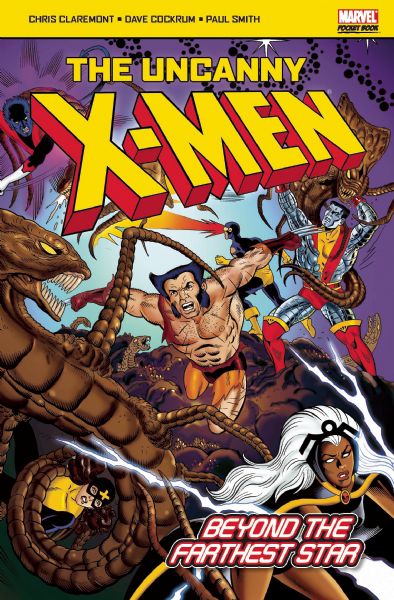
Uncanny X-Men; Beyond The Farthest Star, Chris Claremont

"The X-Men are a million miles from Earth, at the mercy of a rcae if deadly creatures known as the Brood. Infected with parasitic larvae, the mutant team must find a way to free themselves from the alien's insectoid clutches before they are transformed into new Brood warriors. An epic battle ensues as the X-Men struggle to stop their foes, whilst desperately fighting to keep control of their minds and bodies. Returning to earth for a final showdown the group must then confront one of their strongest members ho hass been infected with the embryo of a new Brood Queen. Get ready fro some classic X-action at its very best."


This is the bit where I geek out about just how strong this run on the X-Men is and everyone gets bored silly because this is, what, the third time now? The fourth? Who cares! This is magnificent. Claremont's world building is ridiculously vast, and it shows here where the conflict ranges from space battles, war on alien worlds, to internal struggles for the control of self.

Even the most ridiculous stuff (an over-reliance on cloning and magical-healing is already beginning to creep in) is counterbalanced by a rich imaginative seam of wonder, from the Brood's space-whale hunts to the idea of Lockheed.

The brood are a weird mix of blatant 'Alien' rip-offs and super creepy 'Invasion of the Body Snatchers' by way of hosting, and their lack of success is a hindrance to what is supposed to be the greatest threat to life in the galaxy.

This isn't the best in the series, by this point Claremont has passed most of the real big moments, like 'the Dark Phoenix Saga' and 'God Loves, Man Kills', and is surfing to a close. It's for completists only, I guess, but really, if this doesn't make you happy, nothing will.


You said it Kitty.

Also Try:
Chris Claremont, Uncanny X-Men: The Dark Phoenix Saga
Brian Michael Bendis, All New X-Men
Joss Whedon, Astonishing X-Men: Gifted

Also Try -Professor Xavier is a JERK edition:
Ed Brubaker, Deadly Genesis
Joss Whedon, Astonishing X-Men: Dangerous
Various, Avengers vs X-Men


Tuesday, February 25, 2014

Avengers: Prelude to Infinity, Jonathan Hickman

"It’s the buildup to the biggest event of 2013! First, Hyperion and Captain Universe begin the godlike education of the transformed Savage Land children. But when the High Evolutionary stakes his claim on the Children of the Sun, Hyperion learns the true cost of the decisions he’s made — as the techno-titan Terminus returns! Then, the prelude to INFINITY begins as all of Earth’s Origin Sites go active — and the planet begins communicating with something much more ancient than humans. And when alien races fleeing an intergalactic terror crash to Earth, Captain Universe and Manifold must take a trip across the universe. Whatever happened to Ex Nihilo, Abyss, Starbrand and Nightmask? As the Avengers recruit more members to deal with the mounting threat, the Builders enter the Marvel Universe — and INFINITY is upon us.  Collecting AVENGERS (2012) #12-17."


I think that it's probably fair to say at this point that I am unashamedly pro-Hickman's run on Avengers, even if there is a hard-core contingent of fans who believe his style of long-play, character presence heavy stories. Just as there were people who said that Bendis 'ruined' Avengers (he didn't), or Johns 'ruined' Avengers (still no), there are now some who seem convinced that any Avengers story that wasn't written, drawn and inked in either the 1960s or by Kurt Busiek doesn't count. So, Jonathan Hickman has 'ruined' Avengers, in the sense that he has expanded the cast, introduced interesting new characters, and crafted an ongoing series of arcs that require attention and comprehension skills beyond recognising who punched who.

Complicated doesn't always mean cerebral - it's a mistake that Doctor Who has suffered from over the last few years - but in this case it often works. It's certainly true that the huge number of characters who are now Avengers means that not everyone gets the spotlight every issue, but in creating new characters who all feel like they could hold their own for years to come Hickman reinvigorates the franchise, and has set it in a bold new direction. This isn't Bendis's street level team, but a cosmic crowd. Any team that can boast Hulk, Thor, Hyperion, Captain Marvel, Starbrand, Captain Universe as just the most over-powered of their membership is going to be powerhouse, so throwing in what would have been the New Avengers in years past, as well as the more classic line ups, allows for a greater rang of stories - note the difference between the battle with Terminus, the assault on the origin site in Canada, and Shang Chi vs. ninja's in a Chinese casino.

It's certainly true that character development in the overly monologuey style beloved of Bendis, the kind that requires you to pick up comic after comic to see the seeds sown in one chat play out, but reading this in trade makes it a better proposition. I can only imagine how unejoyable it may feel to get so little out of one issue, but that's, sadly, modern comics.

Also Try:
Jonathan Hickman, The Manhattan Projects
Jonathan Hickman, Secret Warriors
Brian Michael Bendis, New Avengers


Saturday, December 7, 2013

New Excalibur: Battle for Eternity, Chris Claremont

"Chris Claremont makes his triumphant return to New Excalibur! The fight has begun. The battle that's been building since the very beginning of the series is finally coming to a head. Captain Britain must take on his opposite for a battle that will be waged upon many worlds. Plus: One of the team members suddenly succumbs to an all too real tragedy. The team must pull together and care for their fallen friend while their own lives fall to pieces. Collects New Excalibur #16-24."


If the Excalibur (or eXcalibur) of Warren Ellis was all grim and gritty spy fare with a dash of sci-fi thrown in, this is pure, unadulterated Claremontian superheroics.


Or at least it is AFTER the first few issues, which instead choose to focus on ... Nocturne suffering a stroke. If you can imagine the mood whiplash of that being the lead in to an alternate version 'evil' Captain Britain showing up to invade London with an alternate version 'evil' X-Men, whilst a diverse eXcalibur team battled against overwhelming odds to defeat them and save the Queen from execution. Well, actually, it's rather impossible to imagine that kind of mood change.


So if you do read this book after reading this, just skip those first few issues. It's not worth it. Much like the powerloss chapter about the depowered mutant who almost inadvertently dies because he can't fly anymore, it's a taste of the real world that certainly has a place in comics, but rarely works alongside the convention of capes and baddy punching.


Is it good? Rarely. Is it enjoyable? Assuredly so. Will you miss anything by not reading it. Not at all.


There's a lot of Claremont comics to get out there, this isn't even top 30.


Also Try:

Chris Claremont; X-Men
Mark Millar, Ultimate X-Men
Joss Whedon, Astonishing X-Men
Christos Gage, World War Hulk: X-Men

The Korvac Saga, Jim Shooter

"He hails from an unimaginable era: the 31st century. Fleeing through the timestream from the pursuing team of futuristic defenders known as the Guardians of the Galaxy, Korvac the Machine Man has established a secret presence on present-day Earth in the self-created persona of the mysterious Michael. Through such an unassuming guise, Korvac contemplates the elements of a universe he thirsts to command. Yet despite the subtlety of Michael's machinations, the world's greatest super-team - the mighty Avengers - catches wind of his cosmos-conquering scheme, thus drawing the two titanic forces into inevitable conflict."


I picked this up rather randomly in a little second hand Sci-Fi bookshop at the top of the street I work on, a shop notable more for it's devoted attempt to replicate the Black Books experience. To say that its proprietors are disinterested is to do them a grave disservice, they have elevated the idea of apathy to a laconic art form, barely shifting from their amply cushioned positions to extend an ungrateful hand for the cash that disturbs them from the daily routine of opening up, reading and closing time.

That having been said, they always have a weird array of old comics and an excellent back catalogue of trade paperbacks and pulp fiction. Having never read the Korvac saga before, or indeed much early Avengers, it was worth picking up a cheap pocketbook version just to get to grips with a character who is bigger in impact than in actual appearances.

In fact, the only real reference I've ever seen to him was a two part story in Avengers Academy where Korvac reappeared to fight almost every Avenger and trashed them with ease.

What's surprising about the Korvac saga is how little of it is actually related to Korvac. His appearance is scattered through multiple comics before he actually meets the Avengers - battles against the Collector, team-ups with the Guardians of the Galaxy, even Ultron shows up before we actually see Korvac. So whilst the actual fight sequence is amazing, an excellent demonstration of how overpowered the Avengers are by the cosmically fuelled being, it's a little bit of a let down.

In fact, the majority of the book is pretty dull really, which is definitely not what I expected. It doesn't help that the original Guardians of the Galaxy are one of the most dull teams to ever appear in comics, certainly if you have only the experience of seeing them appear alongside the far more interesting (and, importantly, starring) Avengers.

Ultimately, despite its status as a 'classic' this is an unsatisfying and laboured read, one which is hampered by an all over the place cast and a slow burn narrative that drags rather than exciting. Try other stuff first.

Also Try:
Christos Gage, Avengers Academy
Jonathan Hickman, Avengers
Stan Lee, Fantastic Four
Dan Abnett, Annihilation 

Friday, December 6, 2013

X-Factor: Happenings in Vegas, Peter David

"Remember when we warned you about the shocking twist involving Madrox's baby? Remember when the return of Shatterstar wound up making every comics-related website? Well, that was just a warm-up for the shocking events in this volume. X-Factor gets a new client, a tall green-garbed woman with a deadly secret, but that's just a set-up for the jaw-dropping surprise to come."


X-Factor is a tonally strange comic to pin down, being, as it is, a detective comic with a cast of mutants and others than generally tends towards the soapier side of pulp fiction, and features some of the most character-led plot in the entire genre.

And that also, from time to time, features actual superheroes appearing and engaging in heroic battles, as though that were what this is a comic about.

But it isn't, it's not your general superhero battle book, although there are plenty of fight scenes. It's not Heroes for Hire, and it isn't the X-Men, it's a weird halfway house of both, and like the latter it is ALL ABOUT the character arcs.

This is a little disappointing then, because by and large this is a self-contained arc, featuring some set up for future stuff, some extra little conflicts on the side, and a main plot that features the X-Factor group teaming up with Thor to fight dead vikings in Las Vegas, a city which has almost no native heroes that I can think of but routinely gets trashed.

Oh, the Thor stuff is fine, but from a series that started off exploring sex crimes of the super people, or sent its main characters off into the future to fight in the Summers rebellion, a Noodle incident that had been referred to for decades beforehand, a vignette on how women are tricky things to understand and how Thor can hit things isn't quite as cool.

Also Try:
Peter David, X-Force: The Invisible Woman has Vanished, Madrox
J. Michael Straczynski, Thor


Monday, November 18, 2013

Excalibur Visionaries - Warren Ellis Vol. 1 and Vol. 2, Warren Ellis


Born in whimsy though it was, the British mutant team had its share of dark days - never moreso than under the horrific hands of Warren Ellis Excalibur enters the Genoshan war zone with Peter Wisdom, smoking sardonic spy extraordinaire, as their guide Plus: Nightcrawler's magic girlfriend Daytripper joins the cast when a sorcerous struggle centers on Shadowcat's Soulsword Mutant terrorism, extraterrestrial espionage, and more Guest-starring Wolverine


Romance is in the air for Englands's Premier super-team! Captain Britain loves Meggan, Pete Wisdom has moved in with Kitty Pryde, Nightcrawler and Day Tripper are back together, and Wolfsbane and Douglock are best friends! But things don't stay rosy long as the team faces threats from a group of Brood in the future, an all-powerful X-Man and...Colossus!? Plus: The Starjammers save the Shi'ar Empire! 


I read these two together, so rather than splitting them into the two books that they came as I'll just review them as one.

I was initially drawn to these for two reasons, a fondness for Warren Ellis, and a particular love of Excalibur (or eXcalibur, as it's often titled), the English X-Men. Marvel have had a long history of creating excellent UK titles, most recently in Cornell's Captain Britain books, although the Marvel UK brand is relaunching imminently.

A further draw was that the second book features the appearance of Colossus, although as it turned out that was less positive than I had hoped, as my favourite character basically turns up to be jobbed as a villain.

There's certainly a lot to love, especially in the first volume, but compared to the Claremontian run (which I'll review some of soon, as I've also been reading that) it's not half as fun. It's certainly better, but it's not as enjoyable, especially once we get into the second volume which just gets duller and duller without an overarching plot.

I would reccomend the first volume certainly, it brings a nice Sci-Fi and Spy vibe to English heroics, which is entirely fitting and nicely distinguishes it from the much more clearly super-heroic American set. The second, not so much though, as it all topples over into turbulent boredom.

Also Try:
Warren Ellis, Planetary
Chris Claremont, eXcalibur
Paul Cornell, Knight and Squire

Tuesday, September 10, 2013

X-Men; Powerless, Alan Davis

"Mutants are supposedly evolution's next step, but the High Evolutionary doesn't like where it's headed! All over the world, mutants are robbed of their powers, leaving X-Men and adversaries alike on the edge of defeat! But who is the Evolutionary's mysterious patron, and how is the disempowerment his next step? Plus: threats from the Acolytes, the Neo, and more! Guest-starring the New Warriors, X-Force and more than thirty years' worth of robots! Collects Uncanny X-Men #379-380, Cable (1993) #78, X-Force (1991) #101, Wolverine (1988) #149, and X-Men (1991) #99."


Proving that there really are no news ideas at all, here is the pre-House of M story of mutants losing their powers as the High Evolutionary and Mr Sinister devolve all mutants to baseline humans. Now, this is the kind of story that was obviously the inspiration for a later big event, and it's honestly (and unsurprisingly) handled a lot better by Bendis in House of M and by the X writers in every X-Men book after that until Second Coming.

Still, this is a pretty neat little book, that allows the X-Men to showcase what they do (go to space and beat up scientists mostly) whilst also giving Polaris a chance to do something with an actually interesting Magneto plotline.

The main problem with the book is that it's one of those classic X-tie ins which feature issues from half a dozen separate books, with competing art styles and plot lines to flesh out the idea. So alongside the main story in Uncanny X-Men and X-Men you also get a truly rubbish Cable story with some of the most pedestrian art imaginable and a totally out of place tale of Wolverine fighting robots with Nova and the New Warriors whilst dying of Adamantium Poisoning. He almost gets killed by a Spider Slayer, and it is awesome.

Also Try:
Brian Michael Bendis, Avengers: Disassembled, House of M
Brian Michael Bendis, Uncanny X-Men
Grant Morrison, New X-Men
Mark Millar, Old Man Logan

Monday, August 26, 2013

X-Men Forever; The Secret History of the Sentinels, Chris Claremont

"Comics legends Paul Smith and Terry Austin join the X-Men Forever team! As the X-Men attempt to recoup from brutal recent events, they're tested by an unlikely obstacle. Meanwhile, something big has surfaced in South America - an enemy the battered X-Men will have to face head-on! Collects X-Men Forever #6-10."


X-Men Forever, even by the standards of any series that has been running for 40 years, is probably the most continuity-snarled and least accessible book I have ever read. It's part continuation of the original Uncanny run of Claremont, designed to show 'what would have happened' if he had stuck around, but exists in its own continuity (where death is permanent, Sabretooth IS Wolverine's Dad, and Storm is evil).

So If you can keep up with it being a book designed exclusively for X-Men fans who want to see the 'real' Claremontian story completed that has no actual continuity or canon reality, then here is a book for you.

And boy, is it weird. This is volume 2 of the book, and considering that I've not read the first I was pretty lost. Storm has been cloned as a child and her holder version has gone evil. That's the easiest twist to explain in a series that also features a blind Sabretooth living in the X-Mens house so that he can more easily hunt Kitty who now has Wolverine's claws. It's just totally nuts.

The story itself is pretty run of the mill stuff - Nick Fury shows up when Sentinels attack his men in South America. The X-Men head off to fight them alongside Nick and Daisy Dugan (daughter of 'Dum Dum'). We then get a secret origin of Nick Fury and Wolverine, where they meet to fight Sentinels in World War Two. Don't question it.

The arts pretty, the story is characteristically bombastic, and even if it doesn't add anything new it's fun in its own slightly nuts way. But ultimately this is a tale that didn't need telling, that has no consequences at all for the X-Men, and serves as a slightly worse Elseworld or What If? tale.

Pick up Ultimate X-Men instead. Unless you really, really miss Chris Claremont.

Also Try:
What If?
Mark Millar, Ultimate X-Men
Chris Claremont, New Exiles
Chris Claremont, Uncanny X-Men

Friday, August 23, 2013

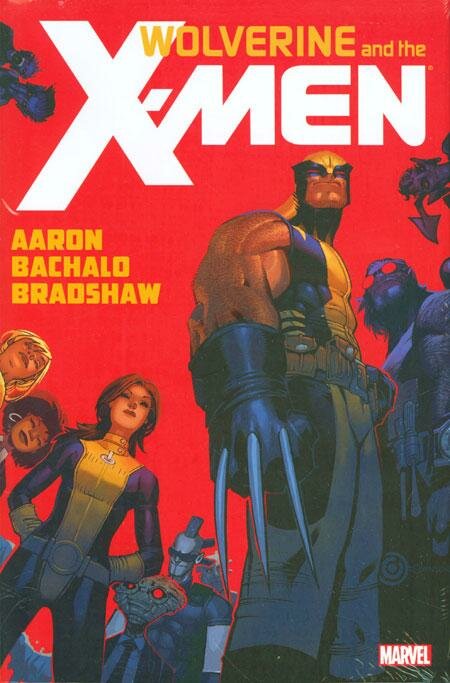
Wolverine and the X-Men Vol. 1, Jason Aaron

"Wolverine has taken half the X-Men back to Westchester to start over with a new school and a new mission. Schism tore them apart, but can Wolverine lead the new Children of the Atom into the future? Only if they survive the new Hellfire Club and the return of another classic villain! Collecting: Wolverine & The X-Men 1-4"


This is the one of the two that I least expected to like. Despite it having an artist I really enjoy I don’t really have any idea about Jason Aaron before this – I'm aware of some of his previous work but he’s someone like Dennis Hopeless who I know exists, but who just hasn't written anything I’ve been interested in reading (although unlike Dennis Hopeless I'm not viscerally appalled by the output of his I have seen).

The very concept of this is not something I was particularly fussed about – I love the X-Men and I love X-School books, but Wolverine is a character so overplayed in the past ten years that I instinctively try to avoid books he’s appearing in.

Working in the youth sector I quite often get exposed to some truly bizarre slang. My personal favourite is DBI, or ‘Don’t Beg It’ a phrase used in conjunction with a withering look to let the recipient know that their enthusiasm is offputting, and that they risk looking desperate if they continue with whatever they’re doing – they’re begging for attention, and should stop. Since the success of X-Men: The Movie, Marvel have pushed Wolverine as THE X-Man of note. It’s a common joke that Wolverine’s real mutant power is that he can be in multiple places at once, due to his presence on a few X-teams, the Avengers, his solo titles and whichever monthly book needs a boost.

So the idea that, post-schism, Wolverine has split from the majority of the established X-Men to go and set up a school (The Jean Grey School, just to rub it in Cyclops’ face that little bit further) doesn’t just stretch credulity on the basis that this is a man who moonlights on a black-ops team that seeks out potential threats to mutantkind and murders them. Quite how he can be headmaster of a school (presumably on a normal teaching schedule) whilst also enforcing world peace with an Avengers team that he’s still nominally part of and teaming up with whichever character has seen drooping sales is beyond me.

So, Marvel, from the start; DBI. Wolverine is overplayed. Unless it’s a relaunch of the incredible ‘Wolverine and the X-Men’ cartoon that was cancelled a few years back I am not interested in anything that has Wolverine in the title.

Except.

This comic is brilliant.

I really never expected this but somehow of the two X-titles I picked up (Gillen’s Uncanny X-Men was the other) this is the one I loved.

It’s not hard to put my finger on what I loved about it, but it’s definitely a surprise to me. It’s not the art – whilst I like Chris Bachalo a lot, and think that some of his X-Men art is superb, his style isn’t a good fit for this book. His messy, living characters need more room to breathe and it’s noticeable that he’s at his best when dealing with more established, monstrous characters; his Wendigo, Krakoa and Ice Men are excellent, but his Wolverine frequently looks too bestial to fit with the school look that is being pushed, and there’s on panel in the second issue where he’s either twist his entire head round or the arms have been drawn on the wrong way. Either way, it’s not his finest. Things pick up a lot once Bradshaw steps in, and his art is wonderful.

But by this point, despite some sub-par artwork, I was already hooked because this is excellent, classic X-Men standard storytelling. There’s a refreshingly wide cast, from Kitty Pryde and Iceman, to the students, as well as a strong debut from the new Hellfire Club.

Normally Wolverine doesn’t work especially well alone because he requires something to rail against. It’s one of the reasons why the classic Cyclops/Wolverine argument works so well; Scott is all about control and Logan is barely suppressed rage. They’re the classic straight-man-fall-guy of superhero dynamics. Without someone to rail against Wolverine doesn’t especially work. He’s not interesting enough on his own, in part because he’s not especially unusual compared to the majority of the Marvel Universe, where nearly everyone is conflicted, and most heroes are happy to kill whenever it’s necessary.

But Aaron makes the great connection that the straight man he’s raging against is himself. Wolverine’s most difficult battle is to try and turn his back on that life and create a stable home for a bunch of superpowered pre-teens.


At one point, there’s a cover of Quire (code name: Kid Omega) with a graffiti sign behind him remarking ‘Do You Remember When Wolverine Was Interesting? Me Neither’. It’s a pithy put down, but it’s not quite right. Because this is where Wolverine is showing that he’s not begging it. And he’s not been this interesting in years.

Also Try:
Joss Whedon, Astonishing X-Men
Grant Morrison, New X-Men
Brian Michael Bendis, All New X-Men and Uncanny X-Men
Christos Gage, Avengers Academy

Uncanny X-Men Volume 1, Kieron Gillen

"In the wake of Schism, Cyclops leads a team of X-Men whose express purpose is to deal with extinction-level events. Meet the X-Men's ""Extinction Team"": Storm, Emma Frost, Magneto, Namor, Colossus, Danger, Magik and Hope. And the team's formation hasn't come a moment too soon, for Mr. Sinister has brazenly taken possession of the massive alien Dreaming Celestial - an act of open hostility designed to put the X-Men in their place, but also an offensive that will draw the attention of the godlike Celestials themselves. Collecting: Uncanny X-Men 1-4"


I got two X-Men graphic novels in a bid to catch up on the post Schism story lines as I'm loving the current run of X titles from Marvel. For those who are unaware, Schism was the sundering of the united mutant front into two separate sides, led by Cyclops and Wolverine. After years of simmering romantic competition over Jean Grey, a mutual distrust of one another's methods and the fact that they're just a ridiculous buddy cop duo (uptight control freak mutant leader meet psychotic berserker Samurai super soldier) their relationship utterly broke down and leads to the creation of two separate teams of X-Men.

With Wolverine off teaching school in Wolverine and the X-Men, Scott is left in Utopia leadin the cool mutants, like Magneto, Colossus and Doctor Nemesis. So, we have the best, and most powerful characters, characters bunched into a single 'Apocalypse Team' and it's written by fan-favourite writer Kieron Gillen! So, I was pretty excited about this one, certainly more than Wolverine's title.

Sadly, this isn't living up to expectations. Gillen can be bait hit or miss, and for a writer who is known for his ability to create 'the feels' he's created an exceptionally sterile narrative. Part of this is down to the large cast; with a focus on Scott and Emma Frost, mutant messiah Hope, Storm, Danger and side characters galore there's very little here to allow anything like emotive resonance.

But a bigger problem is the villain; Mr Sinister is probably one of the most underwhelming enemies the X-Men have. I don't really know what his deal is. He's an immortal Victorian geneticist obsessed with mutants, and the Summers bloodline especially, who wants to create a master race and was the lieutenant for Apocalypse? And he can shoot energy and has psychic powers? Or something.

Whatever, the point is that he's a rubbish villain, which make an introductory book that features him creating an entire city of Sinister's to fight the X-Men slightly boring. It doesn't help that the back up story is all about a mechanical parasitic alien that turns people into robot duplicates. That's two stories about impersonal replicants in one book! So if you're into that kind of thing, go for it.

Also Try:
Joss Whedon, Astonishing X-Men
Age of Apocalypse
Judd Winick, Exiles
Victor Gischler, X-Men: Curse of the Mutants
Jason Aaron, Wolverine and the X-Men

Sunday, July 21, 2013

Agents of Atlas: Dark Reign, Jeff Parker

"The heroes of the 1950s are back with big plans for the 21st Century! When Federal enforcers under the hand of Norman Osborn burst into an armory under control of the Atlas Foundation, Jimmy Woo's Agents go head-to-head with the new powers that be. How it all goes down will make the playing field of the modern Marvel Universe more volatile than ever! This edition comes packed with extras, including a 1950s flashback to the Agents of Atlas' first savage encounter with the man now known as Wolverine! Plus, the Avengers must enlist the help of the Agents to help take down Kang the Conqueror! And discover the key role the Agents of Atlas played in Marvel's blockbuster event of 2009 in Secret Invasion: Who Do You Trust?!

Collects Agents of Atlas #1-5, Wolverine: Agent of Atlas, Giant-Size Marvel Adventures Avengers, and material from Secret Invasion: Who Do You Trust? and Dark Reign: New Nation."


Agents of Atlas is another of those books like The Defenders or Heroes for Hire that appears on the periphery of the Marvel Universe every now and again, and contains some great little all-ages stories without ever getting a long running ongoing book. This collects the Dark Reign tie in issues, which is a great fit for what is essentially the heroic Thunderbolts - a team of heroes pretending to be villains so as to create a peaceful world using the resources of a criminal empire.

Like Thunderbolts it allows for the lesser known heroes and villains of the Marvel Universe to get a look in; these books feature Temugin (son of The Mandarin) and everyone's second favourite bear themed character, Grizzly. It also showcases some more prominent characters from the Avengers era, including Bendis' New Avengers, The Sentry and Norman Osborne, and Wolverine. It's a broad cross section of popular and unknown characters that makes the book a joy to read. As someone who loves the one-page cameo and the intricacies of continuity an appearance from Man Mountain that ends with him being eaten by a dragon is a thing of joy.

There's a real light hearted ness to the book. One of the things that it succeeds in so well is telling a range of different stories. The Agents of Atlas as a whole are a collection of broad archetypes; a Spaceman, a Spy, a Gorilla, a Siren, a Robot and an Atlantean in a series of crime super heroics that owe as much to James Bond and Jackie Chan as to anything else. It means that as well as the exploits of the agents in the Dark Reign era you can have missions set in 1958 (yellow peril and red scare spy-jinks) absurd Kung-Fu battles or sic-fi invasions of revolutionary Cuba. Absurd, but wonderful.

It channels the same structured chaos of NEXTWAVE, and whilst it never reaches the heights of that comic, a book that is the single defining extrapolation of all comics ever, it does a good job of bringing in the wider reaches of a super heroic world.

Basically, it's crime and spy stories featuring a super hero team up in which a talking gorilla fires machine guns whilst a robot shoots a death ray from its head. If that doesn't sound like the kind of book you want to read then, Brother, you've got no business reading comics.

Also Read:
Warren Ellis; NEXTWAVE: Agents of H.A.T.E
Jeff Parker, Thunderbolts
Brian Michael Bendis, New Avengers
Matt Fraction and David Aja, Immortal Iron Fist

Sunday, July 7, 2013

Battle Scars, Fraction, Eaton and Yost

"Spinning out of the incredible events of Fear Itself, Battle Scars introduces a man in the crosshairs of the world's most deadly super villains. Who is he? And what does his existence mean for the future of the Marvel Universe? This major new title ties directly into the Marvel Fear Itself event and stars the Avengers."


Battle Scars is a pretty average book that sets up a lot of better books, and achieves its key aim of introducing a black Nick Fury and Agent Coulson to the mainstream 616 Marvel Universe, to tie it into the movie universe more easily. It's not pretty, but it does the job, and frankly on those grounds it's probably considered a win.


It's the very obvious definition of a comic that Marvel doesn't intend anyone to actually read. It's just there to be a part of continuity, so that they can point back to it as having happened. Marcu Johnson and 'Cheese' are two characters that feel wholly out of place in the Marvel universe - the stakes that they go up against (fighting Deadpool and Taskmaster) undermine those characters by association.


They aren't on the level of Johnson and Cheese. They shouldn't be at the same level. Putting them up against villains who have regularly taken on entire Superteams isn't just jobbing; it's stupidity.


Also Try:

Mark Millar, The Ultimates
Gail Simone, Agent X
Fabian Nicieza, Cable and Deadpool

Captain Britain and MI13, Paul Cornell

"The Skrull Invasion isn't restricted to the US - when the Skrull Invasion his England, only Captain Britain and MI:13 stand in their way. With the fate of Britain hanging in the balance, can the heroes find out what the Skrulls are after before it's too late? This thrilling graphic novel ties in with Secret Invasion."


I LOVE this book. I'm currently reading a bunch of books about Britishness, and what it means to be English.

I'm reading a book on anthropology, a history of the English, and a book on popular English traits. And none of them, none of them, make me feel quite so proud to be British, or quite so happy about my country as this book. It's a bizarre source of patriotism, but if any comic can do it, it's this one.

This isn't a Captain America style patriot bash, it's definably British. And it's wonderful.

There are a couple of scene here that make this comic essential, and whilst its definitely a series that got better post-Secret Invasion (the Dracula war that comes up at the end of the run is exceptional) its a truly strong start. Compared to the last Cornell book I read, this is a world apart.

There's a strong current of Britishness through it, from its treatment of the army and government to little throwaway characters such as John the Skrull or Tinkerbell. But it's the scenes of ordinary people that's stand out, from the death of Captain Britain, to the way the army makes its stand against the Skrulls on Westminster Bridge.

It's a book that has Britishness through it, to its very core, just as Knight and Squire for DC is a book that translates common American superheroics to a British setting. It takes those tropes and without ever undermining them, it builds on them to an extent that elevates everything that was previously there.

Compared to the main thrust of Secret Invasion this is almost throwaway. What it sets up for future arcs (the return of a single Captain Britain, the release of all evil in the British Isles) is totally confined to this book, this isn't something which spills over to others. In fact, the only time we see any of the main Marvel players is in the final arc; this isn't a series that needs to prove itself in relation to its American cousins. It doesn't need to be. It's great as it is.

If you're British and a comics lover (or even if you're just one of those) then this is a book to read, and re-read.

Also Try:
Paul Cornell, Knight and Squire
John Cleese, Superman: True Brit
Chris Claremont, Excalibur

Ultimate X-Men: Return to Weapon X, Mark Millar

"Now pawn of the mysterious weapon X program, the mutant heros' only hope lies with the one team member to evade capture: the enigmatic, unproven Wolverine! Can Logan go it alone against the shadow-ops organisation that transformed him into one of the worlds most lethal killing machines."


I remember pretty clearly the first time that I read this book. It was at an Ottakers around the corner from my school and I was captivated by a scene in which Wolverine daydreams his slaughter of the rest of the X-Men. That's the kind of book this is. One in which the heroes hate one another, and wish they could kil one another. It's Mark Millar's X-Men, and its an excellent second Universe book.

This is not how I want all my X-Men books to be mind. The Astonishing, or All New , or Uncanny books at their best over the last few years have blown this out the water. But it's an unbelievablely good way of introducing the X-Men in a new way, not just as victims of prejudice, but of state sanctioned murder, persecution and rendition.

It's an extraordinarily political book, just as the Ultimates is a celebration of the power of the US, this is a deconstruction of the vagaries and dissembling of state power. The framing of the Weapon X programme as a black ops group operating through SHIELD removes the ridiculousness of Department H and the Canadian super-soldier programme, introduces a raft of new characters (Rogue and Nightcrawler stand out) and adds depth to the Wolverine and X-Men relationship.

There's a lot to love here, and its another one that sworn a read. It can get dark at times, so if you prfer your superheroes light and bright, I would avoid it, but if you like some dysfunctional, unusual ideas with a side helping of mutant on mutant conflict, this is your book!

Also Try:
Mark Millar, The Ultimates
J Michael Straczynski, Squadron Supreme
Peter David, Young Justice

Ultimate X-Men: The Tomorrow People, Mark Millar

"Star writer Mark Millar delivers Marvel's mutant heroes in a streamlined, character-rich adventure perfect for fans of their smash hit movie. Brought to life by the talented Kubert brothers, the X-Men fight for the future in this break-neck thrill-ride.Mutants, those born with strange powers, through genetic mutation, are not only hated and feared, but brutally murdered in the streets by U.S. sanctioned killing machines. Driven by a dream of peace, Professor X gathers his mutant soldiers, his X-Men, to try and bring sanity to an insane world. But can he forge his band of misfits into a strike force capable of defending the Earth from the evil Magneto and his Brotherhood and even from the very humans they seek to protect."


The Ultimate line was a great idea, an attempt to create an Earth 2 style spin-off line of continuity free, newly restarted heroes that welcomed new readers and retold classic stories in an updated setting. Spearheaded by Mark Millar's Ultimates and Ultimate X-Men it was an uncomplicated method of trying to take people who had seen the super movies of the early '00s and translate them to comic sales.

Over a decade later it has developed its own vast and sprawling myth arc and is as undeniably complex as the mainstream Marvel Universe (or Reality 616), despite attempts to reduce and simplify the cast through mega crossovers like Ultimatum, in which roughly half of all introduced heroes were killed off (including 90% of the recognisable X-Men). The Ultimate Universe has become a series of diminishing returns, with the notable exception of Ultimate Spider-Man, which has enjoyed a creative resurgence since killing off original Spider-Man Peter Parker and introducing legacy character Miles Morales.

But back in the day these were some of the best comics around, especially as an introduction to the wider Marvel Universe. They emerged at a perfect time for me to get into them as I started to read comics, and are fully responsible for my love of Marvel over DC. In reselling classic stories and reintroducing classic heroes and villains, they name dropped enough that I actively sought out those characters more.

Tomorrow People serves as a particularly excellent introduction to the X-Men, complete with teenage angst and the perils of being unwelcomed defenders of humanity. Much like the animated series, it opens with the sentinels rather that Magneto, leaving the reader in no doubt about who the real villains of the comic are: humans.

It also distils the original lineup down to a few of the more interesting characters: no Angel, Banshee. Havoc, Polaris, Sunfire or Thunderbird in this line up, so we're left with the pick of the original line-ups. Most of these will be introduced within the following few books, including Nightcrawler and Kitty Pryde, but the distiller adaptation of everything X-Men, from films to TV, and ever some comics lore, means that you have a potently crafted mix which brings together the best line-ups and origins.

If you want to know where to start with comics it's hard not to suggest this - its a stand out first read, often funny and relatively realistic in comparison to the 60s X-Men, or even their 616 counterparts.

Also Try;
Brian Michael Bendis, Ultimate Spider-Man, All New X-Men
Grant Morrison, New X-Men
Joss Whedon, Astonishing X-Men
Mark Millar, The Ultimates

Friday, May 17, 2013

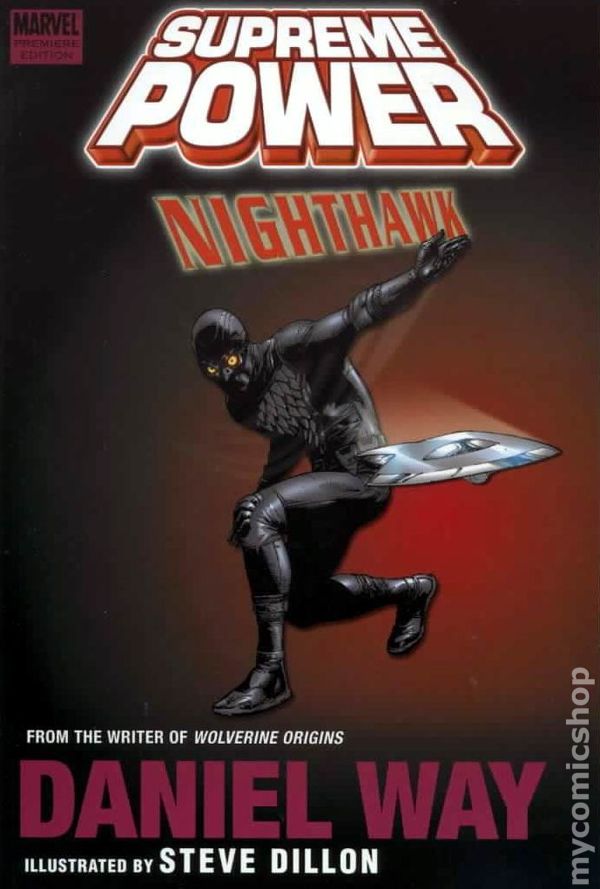
Supreme Power: Nighthawk, Daniel Way

"As a boy, Kyle Richmond - the man who would one day become Nighthawk - witnessed the senseless murder of his parents. There was no reason for their deaths, no provocation - they were just simply in the wrong place at the wrong time. It was a traumatic event that has left him scarred for life - and turned him into a hero more feared than the criminals he polices. Now, it's happening again... but on a much larger scale. The people of Chicago - men, women and children - are dying in the streets, victims of a monster whose thirst for slaughter cannot be quenched, whose soul is a bottomless void and whose scars run even deeper than Nighthawk's. Long ago, Kyle Richmond looked into the face of madness - now, it's looking back at him. And it's flashing a killer smile. Collects Supreme Power: Nighthawk #1-6."


The main draw of this is the Steve Dillon art, a guy who is the go to for obscenely sterile violence (read Preacher or The Punisher, and be amazed at the hurt that can be drawn from a guy who doesn't detail his work in any way). Sticking him on an alternative take on Batman vs The Joker is a stoke of genius  and it helps that it's written by Daniel Way, the guy behind some of the best of Deadpool, and another man who's very at home with impressive levels of serious violence.

So there is a competent team in place, and they certainly don't disappoint. Whilst it's an inconsequential tale its nice to see a story that doesn't take its subject matter very seriously. Nighthawk is a character that's rife for this kid of treatment - as a Batman parody he doesn't really work, because he's too in-jokey for the reader. His entire set up in the Supreme Power reality is that of an amoral Billionaire who only intervenes in those cases where he can help black people, and sees everything through a prism of perceived racism.

It's basically taking the concept of Batman as a protector of the weak and turning it to Batman being the protector of some of the weak, the few that are like him, a concept that just makes him ridiculous.

Still, it's amusing to see him breat the crap out of racists and bullies, and his lack of limits make for a refreshing solution when he does confront the joker analogue who is murdering anyone and everyone across Chicago. There's little of substance there, but it works, and it's a nice addition to the Supreme Power universe.

Also Try:
Scott Snyder, Death of the Family
J. Michale Straczynski, Supreme Power
Daniel Way, Thunderbolts
Garth Ennis, Preacher

Supreme Power; High Command, J Michael Straczynski

"In their first adventure as a team, Hyperion, Blur and Nighthawk--the newly formed Squadron--have a long-overdue showdown with the superpowered serial killer who's been terrorizing the nation! But will they live long enough to stop him? Plus: What does the most powerful being on the planet do when he finds out he's been manipulated, and that his whole life is practically a lie? how will Hyperiod react, and what does that mean for the rest of humanity--and the government that's organized these deceitful machinations?"


The Supreme Power books are another of those series that I remember being really excellent when I first read them years ago, and which on a second reading have got both better and slightly worse.

That's all down to the core concept. Reading Supreme Power for the first time, I didn't catch the fact that it's a pastiche of the Justice League, a concept that's so stunningly obvious that only the fact that I didn't read much in the way of DC when I first started reading comics and so didn't catch analogies to Green Lantern and Aquaman, who at that point were still obscure enough to not be a superhero I would recognise.

On reapproaching the series then there's al ot of extra depth in the story of Superman in the real world, a concept that's been done to death, but rarely so comprehensively or as well as it is here. The genius of Straczynski is in linking everything to Superman (Hyperion) arriving on earth - the emergence of a Godlike figure leads to the creation or revelation of others.

It's easy to draw parralels from this to the rise of cape comics in general, as Superman was one of the first comics to move away from the pulp action hero genre into full superheroics, and can be seen as the first great comic run, even if it wasn't the first superhero comic

Every other hero (and villain) stemming from the emergence of Hyperion is a nice way of representing this, and it adds an extra layer to a character who is at his best when inspiring others to greatness. It's further layered on by the fact that the majority of the action of humans in the comic are resolutely imperfect - they aren't inspired to do better, but to more horrendous actions.

It's a wonderful flip on the Superman mythos which usually just involves Superman 'turning' bad, either in reaction to tragedy - as in Whatever Happened to the Man of Tomorrow, or Injustice: Gods Among Us - or simply being raised wrong - like in Red Son. The alternate version here is still a man with a strong moral compass, who still inspires, albeit one who is confused and lost, abandoned and persecuted by the Government that raised him. He is, in fact, a man who is raised without truth, or justice - the realpolitik American Way.

Anyway, this is a series that by this point is twelve issues in and has just had the first few team-ups between the Justice League analogues. It's a Superman book, in all but name, and anyone expecting much in the way of a team will be disappointed. Of the six superheroes shown only three ever interact at a time, and mainly for a few pages. In nearly every case they fight.

That's one of the issues - it's a team up book that doesn't contain much in the way of a team up. The second is that the last ten years have seen so many edgier, darker takes on the high-profile superteams of the Marvel and DC universe that it's hard to make an argument for this one more than any other. Millar's Ultimates, Ellis's The Authority and Planetary, even Garth Ennis on The Boys - all deconstructed the idea of superheroes and rewrote the rules of what superheroes could and couldn't do.

This is hardly pushing the envelope in terms of this; it's a realistic take on Superheroics, putting it into a context of what would happen rather than asking how far we can push these characters into darker pursuits.

Still, Supreme Power is well worth picking up if you like your comics grand in vision. It's a book that takes a while to take off, but when it does, it soars.

Also Try:
Mark Millar, The Ultimates
Grant Morrison, All Star Superman
Warren Ellis, The Authority

Friday, May 10, 2013

Uncanny X-Men, the Hidden Years, The Ghost and the Darkness; John Byrne

"Before House of M, before Onslaught, before the tragedy ofnthe Dark Phoenix, there were a handful of troubled teenagers and one man with a dream. Return to the X-Men's early days and discover the teams lost tales in this exclusive collection, expertly crafted by legendary comic book created John Byrne. The first seven issues of John Byrne's X-Men: The Hidden Years are collected in one titanic tome for the first time! This series chronicles the adventures of Marvel's original team of merry mutants after their Silver Age saga had run its course, and before the launch of the All-New, All-Different band of heroes. COLLECTING: X-Men : The Hidden Years 1-7"


This one is totally bizarre, a John Byrne scripted look back at the 'missing' adventures of the original X-Men team of Cyclops, Marvel Girl, Iceman, Angel and the Beast. Now, this is a time period ripe for rewriting, as it's widely agreed that the early first X-Men run was not very good, at least until Mutant Genesis and the second team came in.

The problem is that the idea of showing previously unseen adventures of the early team has been done better elsewhere, in First Class. Where as that contained a fresh start for the X-Men that welcomed new readers and old alike, this is a book that is only really relevant to those who have read the full early run, or at least enough to know about the Z-Nox and Professor X's decision to fake his death.

The behaviour of Iceman in particular only really works as part of a larger storyline, and casting the most (literally) chilled out of the original five X-Men as a hot head who quits the team in a huff seems a little bit odd. He's mostly absent for this story, which instead concentrate on Scott, Jean, Warren and Hank journeying to the Savage Land to find the body of Magneto and prove to the Professor that their enemy is truly dead.

Spoiler alert; he isn't.

Although he is a ghost for most of the book; because, the Savage Land.

The Savage Land is such a perfectly goofy comic book concept (mysterious zone in the antarctice circle where Dinosaurs, primitive humans and various other creatures still reside) that's so undervalued by the amount of time that's actually spent there. The stakes are always supposedly raised by a visit there and this never usually pays off, so it's nice to see something more than just the usual 'team turns up, fights a dinosaur, continues as normal' story, and some actual threat from the inhabitants.

Still, this lives up to the early X-Men reputation for being pretty weak. Definitely check out either First Class or All New X-Men instead.

Also Try:
Jeff Parker, X-Men: First Class
Brian Michael Bendis, All New X-Men
Mark Millar, Ultimate X-Men: Hellfire and Brimstone
Chris Claremont, Uncanny X-Men