Showing posts with label Superheroes. Show all posts

Thursday, March 6, 2014

The Violent Century, Lavie Tidhar

"For seventy years they guarded the British Empire. Oblivion and Fogg, inseparable friends, bound together by a shared fate. Until one night in Berlin, in the aftermath of the Second World War, and a secret that tore them apart. But there must always be an account...and the past has a habit of catching up to the present. Now, recalled to the Retirement Bureau from which no one can retire, Fogg and Oblivion must face up to a past of terrible war and unacknowledged heroism, - a life of dusty corridors and secret rooms, of furtive meetings and blood-stained fields - to answer one last, impossible question: What makes a hero?"


A surprise Christmas present from my good friend and fellow Impossible Podcaster Caleb, Lavie Tidhar's World War 2 superhero romp is a work of depth and scope, one which manages to be interesting to both the historian and comic fan in me.

The Second World War is fertile ground for reimagining, with almost every alternate history writer ever having written at least one book set in Europe between '39 and '45. From 'The Man in the High Castle' to 'Fatherland', most revisionists have chosen to present an alternative of Axis triumph - I've reviewed a few already that have included a picture of either a British collapse before 1941 or a comprehensive Russian defeat after, the two most common ideas.

To Tidhar's credit then, this is not simply a 'What If'. Instead, he imagines a world in which superpowers, distributed evenly simply balance out the sides, meaning no war-winning advantage. Forget Captain America punching out hitler, or Superman sinking Japanese ships. These 'heroes' are flawed, weak individuals, whose impact is as important for propaganda (the American super-soldiers) and intelligence gathering (the British super-spies), as actual battle (the Russians).

In fact, each nation utilises it's new powered assets differently, sending some into the heart of the conflict and using the talents of others for their own purposes - the NAZIs begin to use theirs to hunt down Jews and Allied heroes for Dr. Mengele.

It's a hard line to tread, mixing the fantastic with a perils of history that was almost unprecedentedly brutal, with countless atrocities. The Violent Century doesn't shy away from this, instead addressing these head on, and as time passes and it moves onto Vietnam, Soviet-era Afghanistan and the course of history passes unimpeded their presence only acts as a spotlight on the other historical acts of aggression perpetrated by all the Great Powers on their vassal states.

Mixing real events and individuals (featuring cameos from a comic-less Stan Lee and Siegel and Schuster) with the more imaginative (Sabra, the Israeli hero of the Warsaw Uprisings who is killed rescuing hostages at the Munich Olympics, is an inspired example), the book treads a course through much foreign policy of the Cold War years.

The USP of The Violent Century though is not its use of real and imagined characters or narrative sweep, but it's staccato text and grammar-less drive. Entire conversations pass without the need to hang quotation marks or apostrophes. Far from liberating the words, this adds a paranoid, disconcerting immediacy - a sense, intentional I'm sure, that things are not quite as they should be. This is a world without punctuation; what if, rather than "What If?" 

Also Try:
Kieron Gillen, Über
Harry Turtledove, World War series
Stephen Fry, Making History
Alan Moore, Top Ten


Saturday, January 4, 2014

Welcome to Megalopolis, Gail Simone and Jim Caliafore

"When the caped heroes of the world's safest city inexplicably all turn into homicidal lunatics, no one is safe.

The only rational thing to do is get the hell out of town. If only it were that easy..."


I kickstarted this (and it seems like a long time since I did) on the strangth of the fact that I like Gail Simone a lot (even if I've not especially enjoyed her Birds of Prey or recent Batgirl titles for DC) and Secret Six, which she did with Jim Caliafore

This isn't up to that standard, but as an example of world building it's an enjoyable read in its own right. The problem for all creator owned content is that, sooner or later, they have to explain their USP in a market crowded with too many characters, where even big name heroes can struggle to maintain their own series (just take a look at the list of cancelled book from the DC New 52 so far).

Kickstarter provides a medium for creators to release material without the worry that it won't sell. In reality, that's probably not an issue for Simone. She's a big enough name in the industry that her own creator owned stuff is going to sell. If Millar, Vaughan, Deconnick and Wood can do it, then Simone shouldn't have a problem, but clearly the vehicle of Kickstarter is a nice way to release new material.

The problem is that, shorn of the regular release schedule of mainstream comics the book can come across as ephemeral. Simone does an excellent job of creating a city that feels lived in, and Caliafore's art certainly helps. It's Hitchian in its scope and depth, and if his figure work isn't always as strong they certainly seem solid and real. The scenes of wholesale destruction have an appropriate sense of devastation. But without time to spend getting to know characters the death and sadness that permeates the book have little time to take route. Unlike The Walking Dead or Crossed, where a regular release or set of miniseries could bed in the core concept, we are introduced to characters and not given any time to appreciate them before they die.

It's not a bad thing to say, that I would rather there was more of it, but it does feel like a missed opportunity to set up a brand new universe that stands on its own.

Also Try:
Robert Kirkman, The Walking Dead
Brain Wood, DMZ
Simone and Caliafore, Secret Six

Tuesday, September 10, 2013

X-Men; Powerless, Alan Davis

"Mutants are supposedly evolution's next step, but the High Evolutionary doesn't like where it's headed! All over the world, mutants are robbed of their powers, leaving X-Men and adversaries alike on the edge of defeat! But who is the Evolutionary's mysterious patron, and how is the disempowerment his next step? Plus: threats from the Acolytes, the Neo, and more! Guest-starring the New Warriors, X-Force and more than thirty years' worth of robots! Collects Uncanny X-Men #379-380, Cable (1993) #78, X-Force (1991) #101, Wolverine (1988) #149, and X-Men (1991) #99."


Proving that there really are no news ideas at all, here is the pre-House of M story of mutants losing their powers as the High Evolutionary and Mr Sinister devolve all mutants to baseline humans. Now, this is the kind of story that was obviously the inspiration for a later big event, and it's honestly (and unsurprisingly) handled a lot better by Bendis in House of M and by the X writers in every X-Men book after that until Second Coming.

Still, this is a pretty neat little book, that allows the X-Men to showcase what they do (go to space and beat up scientists mostly) whilst also giving Polaris a chance to do something with an actually interesting Magneto plotline.

The main problem with the book is that it's one of those classic X-tie ins which feature issues from half a dozen separate books, with competing art styles and plot lines to flesh out the idea. So alongside the main story in Uncanny X-Men and X-Men you also get a truly rubbish Cable story with some of the most pedestrian art imaginable and a totally out of place tale of Wolverine fighting robots with Nova and the New Warriors whilst dying of Adamantium Poisoning. He almost gets killed by a Spider Slayer, and it is awesome.

Also Try:
Brian Michael Bendis, Avengers: Disassembled, House of M
Brian Michael Bendis, Uncanny X-Men
Grant Morrison, New X-Men
Mark Millar, Old Man Logan

Monday, August 26, 2013

X-Men Forever; The Secret History of the Sentinels, Chris Claremont

"Comics legends Paul Smith and Terry Austin join the X-Men Forever team! As the X-Men attempt to recoup from brutal recent events, they're tested by an unlikely obstacle. Meanwhile, something big has surfaced in South America - an enemy the battered X-Men will have to face head-on! Collects X-Men Forever #6-10."


X-Men Forever, even by the standards of any series that has been running for 40 years, is probably the most continuity-snarled and least accessible book I have ever read. It's part continuation of the original Uncanny run of Claremont, designed to show 'what would have happened' if he had stuck around, but exists in its own continuity (where death is permanent, Sabretooth IS Wolverine's Dad, and Storm is evil).

So If you can keep up with it being a book designed exclusively for X-Men fans who want to see the 'real' Claremontian story completed that has no actual continuity or canon reality, then here is a book for you.

And boy, is it weird. This is volume 2 of the book, and considering that I've not read the first I was pretty lost. Storm has been cloned as a child and her holder version has gone evil. That's the easiest twist to explain in a series that also features a blind Sabretooth living in the X-Mens house so that he can more easily hunt Kitty who now has Wolverine's claws. It's just totally nuts.

The story itself is pretty run of the mill stuff - Nick Fury shows up when Sentinels attack his men in South America. The X-Men head off to fight them alongside Nick and Daisy Dugan (daughter of 'Dum Dum'). We then get a secret origin of Nick Fury and Wolverine, where they meet to fight Sentinels in World War Two. Don't question it.

The arts pretty, the story is characteristically bombastic, and even if it doesn't add anything new it's fun in its own slightly nuts way. But ultimately this is a tale that didn't need telling, that has no consequences at all for the X-Men, and serves as a slightly worse Elseworld or What If? tale.

Pick up Ultimate X-Men instead. Unless you really, really miss Chris Claremont.

Also Try:
What If?
Mark Millar, Ultimate X-Men
Chris Claremont, New Exiles
Chris Claremont, Uncanny X-Men

Friday, August 23, 2013

Uncanny X-Men Volume 1, Kieron Gillen

"In the wake of Schism, Cyclops leads a team of X-Men whose express purpose is to deal with extinction-level events. Meet the X-Men's ""Extinction Team"": Storm, Emma Frost, Magneto, Namor, Colossus, Danger, Magik and Hope. And the team's formation hasn't come a moment too soon, for Mr. Sinister has brazenly taken possession of the massive alien Dreaming Celestial - an act of open hostility designed to put the X-Men in their place, but also an offensive that will draw the attention of the godlike Celestials themselves. Collecting: Uncanny X-Men 1-4"


I got two X-Men graphic novels in a bid to catch up on the post Schism story lines as I'm loving the current run of X titles from Marvel. For those who are unaware, Schism was the sundering of the united mutant front into two separate sides, led by Cyclops and Wolverine. After years of simmering romantic competition over Jean Grey, a mutual distrust of one another's methods and the fact that they're just a ridiculous buddy cop duo (uptight control freak mutant leader meet psychotic berserker Samurai super soldier) their relationship utterly broke down and leads to the creation of two separate teams of X-Men.

With Wolverine off teaching school in Wolverine and the X-Men, Scott is left in Utopia leadin the cool mutants, like Magneto, Colossus and Doctor Nemesis. So, we have the best, and most powerful characters, characters bunched into a single 'Apocalypse Team' and it's written by fan-favourite writer Kieron Gillen! So, I was pretty excited about this one, certainly more than Wolverine's title.

Sadly, this isn't living up to expectations. Gillen can be bait hit or miss, and for a writer who is known for his ability to create 'the feels' he's created an exceptionally sterile narrative. Part of this is down to the large cast; with a focus on Scott and Emma Frost, mutant messiah Hope, Storm, Danger and side characters galore there's very little here to allow anything like emotive resonance.

But a bigger problem is the villain; Mr Sinister is probably one of the most underwhelming enemies the X-Men have. I don't really know what his deal is. He's an immortal Victorian geneticist obsessed with mutants, and the Summers bloodline especially, who wants to create a master race and was the lieutenant for Apocalypse? And he can shoot energy and has psychic powers? Or something.

Whatever, the point is that he's a rubbish villain, which make an introductory book that features him creating an entire city of Sinister's to fight the X-Men slightly boring. It doesn't help that the back up story is all about a mechanical parasitic alien that turns people into robot duplicates. That's two stories about impersonal replicants in one book! So if you're into that kind of thing, go for it.

Also Try:
Joss Whedon, Astonishing X-Men
Age of Apocalypse
Judd Winick, Exiles
Victor Gischler, X-Men: Curse of the Mutants
Jason Aaron, Wolverine and the X-Men

Sunday, July 21, 2013

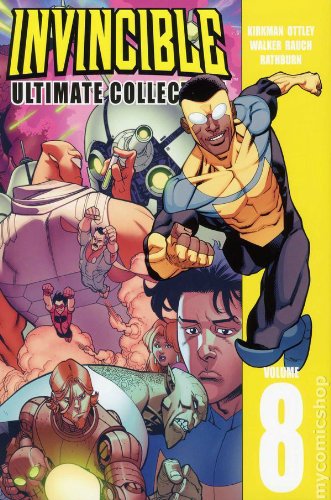
Invincible Ultimate Collection Volume 8: Robert Kirkman

"Collects issues #85-96 of the greatest super hero comic in the universe! In the aftermath of the Viltrumite War, friends become enemies, enemies become allies, and Mark Grayson's future as Invincible ends here!"


I love this book so much guys. Invincible is just such a solid concept, and now nearly 100 issues into these hardback collections it just shows every sign of running and running. What started off as just another super hero comic has grown into a Universe spanning meta-commentary on super heroics. This isn't Animal Man or anything. Don't get me wrong. It's not meta in the sense of self-awareness in universe, but simply in the construction of a superhero epic putting its own spin on everything from team-ups, sidekicks, legacy characters and summer events, all kept to the confines of a single book.

There's something beautiful about the seeming simplicity of Invincible. It's never a comic that feels like it overreaches itself. The character development and passage of time are given the weight required, meaning the characters change considerably from inception. Compare Mark and Eve to their first appearance, and their status is significantly altered, even as his morals, values and perceptions have changed. It's fantastic to see a character mature and grow in a way that rarely feels forced, and never excites fear of slide back. It's one of the best things about creator owned comics for a reader; there is real significance to events. Continuity won't be changed or abandoned, there is no danger of editorial redress to reset to the status quo. Every consequence is felt, dealt with and remembered.

At this point, with the Viltrumite War almost over and the threat of The previous 50 issues seemingly removed, or at least forestalled, this is a chance to change the focus a little. We see some of the fallout of the decisions made during the war, and especially the way it ended, that lead to major shake-ups for the heroes. It also allows for the development of some of the huge supporting cast, in particular an explanation for the breakdown of Monster Girl and Robot's relationship. Between this and the increased presence of Bulletproof as the new Invincible, it's great to see some of the smaller character given their day in the sun. Much like the issues featuring the Guardian reserves against the Lizard Legion these are often the emotional heart of the supporting cast, and the time spent focused on them leaves the impression of a fuller world. It has always been a strength of Kirkman's work on Invincible, and it's one of the reasons why these long run collections work so well - the brick jokes started issues before are given time to mature and flourish before they bear fruit.

As well as the usual great art from Ottley we get the return of Cory Walker, original series artist and co-creator of Invincible, to illustrate the alternate world issues. These are excellent, and it's one of the few times when sharing an artist makes sense. Unlike many anthologies or split art duties the two styles complement each other nicely, whilst still being noticeably different enough to suggest a different aesthetic in each reality. Considering how great Ottley has always been this is a laid back collection - nothing exceptional to talk about. Then again, the most mundane of pages are excellent, and Dinosaurus against Thragg is particularly incredible. Definitely pick this up.

Also Try:
Robert Kirkman, The Walking Dead
Kieron Gillen, Young Avengers

Wednesday, June 26, 2013

Justice League Elite vol 1, Joe Kelly


"They do the JLA's dirty work!

Conflicting goals causes a schism amognt the World's Greatest Super-Heroes. As a result several members of the JLA choose to do undercover work with Vera Black and her super-powered team, the Elite. Their first assignment: infiltrate a small brotherhood of assassins gathering to hit a major political target.


Heroes find themselves suddenly allied with deadly foes. Can this group function effectively enough to do their job? And if they can't, what will happen to the world?"


This one is a really weird book because it features a couple of really great comics (Action Comics 775, and JLA 100) and then a pretty boring main section of the book (the first four issues of the JL Elite run). Those first two comics are brilliant, and AC 775 is a modern classic, but JL Elite is a book that I own all of, and yet it's still a near total stinker, an attempt to create a more mature and realistic comic within the DC Universe that just falls apart due to the fact that none of the non-established characters are terribly interesting.

Taking it piecemeal, AC 775 is the excellent 'What's so funny about Truth, Justice and the American Way', the best set up of who Superman is and his ideals in modern comics. If you've just seen Man of Steel and want to know why it's problematic and doesn't hold true to the character of Superman, read this comic.

What's great about it is that it shows a Superman who is thoroughly interesting whilst still managing to be a paragon of virtue - for anyone who says that Superman is boring, this is a comic in which he collapses lungs by flying at five hundred miles a minute, and shuts down the bad guys psychic abilities by cauterizing the part of his brain that gives him superpowers using just his eyes. It's unexpectedly badass, and shows just how powerful a let loose Superman is, even in comparison to some of the most dangerous villians going.

It's also one of the most hopeful issues going, a theme which is carried over for JLA 100 which features every single nation on earth teaming up to fight a single super-team alongside the Justice League, all so that the personification of Earth won't destroy humanity.

But the actual JL Elite issues are so lacking in hope as to feel like a different writer altogether. Joe Kelly talks in the intro about wanting to create a team that straddled the line between being a force for good and doing bad. It's a big issue, but I'm not sure this is the format for doing it. Ironically it's the Dark Horse, Wildstorm, Image and Vertigo stables where these stories are being told better. It's books like The Authority and Planetary, the very books that Kelly was writing 'What's so funny ...' in response to that are telling these tales better and first.

It's hampered by a cast that's utterly, unrelentingly dull. The character who really stands out is Green Arrow, who spends most of his page time seducing the wife of Maintou Raven and quitting the team in disgust. So, not a huge win here.

Basically this all boils down to one thing; this isn't a good book, but it does feature two really great comics. You should definitely get those. Just ditch the rest of the book before you do.

Also Try:
Grant Morrison; JLA
Brian Michael Benis, Dark Avengers
Jeff Parker, Thunderbolts
Warren Ellis, The Authority

Saturday, June 22, 2013

Superman The Black Ring vol 2, Paul Cornell

"When he briefly became an Orange Lantern in blackest night, Lex Luthor got a taste of true power. Now he'll do anything to get that power back. His quest for the Black Lantern energy takes him to Arkham Asylum for a close encounter with "The Joker", and then into direct conflict with Larfleeze, the ultra-greedy Orange Lantern."


This is a chunkier book than the first volume, featuring as it does the annual and secret six tie in that comeplete the story of Luthor and the black ring. By the time it's done it will get even more bonkers than it was before, with appearances from Ra's Al Ghul, Darkseid and the Joker, as well as Larfleeze and Superman himself, who finally puts in an appearance towards the end.

So the first volume had some strange ideas about what made an enjoyable read, and kind of lost me around the point where creating simulations of your enemies wife to sleep with became a thing. But in amongst that, was some good stuff, in particular a trot through some of the worst of the DC universe that wouldn't have been out of place in setting up a new Legion of Doom.

That continues here, as we get to see more of the most nefarious individuals in the DC universe, and as we venture out into space towards the end the villains become more and more outlandish, culminating in a fight with a Phantom Zone space God.

The problem isn't the side characters, it's the arc for Luthor. Having been set up as a resolutely awful person, there are two ways this could go. Either he fails, and we're pleased, and this is what will happen. Or he wins, and although he's the current protagonist everybody loses out. The questions isn't whether he will fail, but how.

Now usually here, in a book where Luthor is the bad guy you would expect Superman to appear and save the day, either through some feat of strength, or simply by virtue of a stronger moral compass. But this isn't a book where Superman wins, but one where Luthor loses, and that for me is a problem.

Cornell doesn't set up a more positive competing vision of who Superman is, or what he does and why that is better than Luthor's vision. Instead, Luthor loses control of his rage and pumps out all the power he had gained in a futile attempt to kill Superman, whilst acknowledging that in doing so he is passing over his chance to alter the world for the better.

That's very Lex Luthor, and this idea that it's his hubris, and more than just a lust for power but a lust for power over Superman in particular, that dooms him is neat. But it does somewhat ruin what can be an otherwise more nuanced character a little. Lex is the perfect foil for Superman in the same way as Magneto is for the X-Men; neither view themselves as the bad guy. Their cause is just, and is simply contrary to the wishes of the superhero team they compete against. Compared to the Joker (sample plan: poison the water supply) or Loki (evil is funny) Luthor is a picture of sanity. But the root of that has to be that he views Superman as an outsider who threatens humanity, not just his own place and position.

Lex Luthor, for me at least, only works as a true Xenophobe, who believes that Superman holds back human progress - essentially a DC Universe equivalent of the idea that charity to Africa stifles reform there. I love the idea that Luthor may be right; but he can't be that character if he actively throws away these motives on panel. Telling Superman he won't save Jonathan Kent from dying, or that he'd rather kill Superman than make Earth better now doesn't just undermine that part of his character, it destroys it entirely. That entire facet of Lex Luthor is now unworkable.

That's the problem with The Black Ring throughout - it attempts to be a picture of Lex Luthor, and show his side of the story, but it turns out he's just a one-dimensional dick.

Also Try:
Mark Millar; Superman: Red Son
Tom Taylor, Injustice: Gods Among Us
Scott Snyder, Superman Unchained

Superman The Black Ring vol 1, Paul Cornell

"When Lex Luthor finally regained control of LexCorp, he thought he had everything he wanted. But in BLACKEST NIGHT, he briefly became an Orange Lantern and got a taste of true power. Now he'll do anything - anything - to get that power back. Buckle in for a greatest hits tour of the DCU's most wanted as Lex Luthor begins an epic quest for power, all brought to you by new ongoing writer Paul Cornell (Dr. Who, Captain Britain and MI-13) and artist Pete Woods (WORLD OF NEW KRYPTON), with covers by David Finch (BRIGHTEST DAY, Ultimatum)!"


I am a big fan of Paul Cornell, and I had heard interesting things about The Black Ring, the ten issue Lex Luthor helming take over of Superman's 'Action Comics', and a Secret Six tie-in and annual. There's loads going on in here, and I am going to write it up as two volumes, because that's how I read it, although I got both at the same time and read them back to back.

First off, I'm sad to say that I didn't really enjoy the books at all. I found Lex hard to really enjoy. Maybe that's an issue with going in cold, and not knowing any of the current background, but this isn't a comic interested in setting up Lex Luthor as a concerned but misguided corporate titan who believes that Superman is all that stops the world being better.

This is just a straight up awful man. Within three pages he has someone killed, in front of their family, after Luthor has already had him fired for not agreeing to some evil science. This isn't subtle, and there's little done through the book to make you root for Luthor in any way. Every victory he achieves that would have you cheer on a 'hero' character, or even the hero of the tale, anti-hero or not, is actually just a kick in the teeth for the reader.

There's an active sense of wanting Luthor not just to fail, because that's the story that's being told anyway, that less than sub-textual desire for power may make sense in the context of a Luthor who was recently a literal avatar of greed in Blackest Night, but it gets a little over the top by the time he's built a robotic replica of Lois Lane to tell him how great he is, and is touring the world to absorb the embodiment of universal death. This is the plot within the first ten pages.

It all adds up to make a charcter who is utterly repugnant; a man who creates a lobotomised love doll version of his nemeses wife, who shows no concern or hesitation at killing civilians, and who is almost unreadably, insufferably obnoxious. Now, obviosuly, that may pay off in the second volume, but, spoiler alert, it doesn't.

On the other hand, whilst Luthor is horrible to read, the cameo appearances are great. Anything that features Gorilla Grodd (mind controlling, human eating Gorilla ruler of remote African nation). Mister Mind (mind controlling alien slug) and the Sinister Six is alright by me, especially if it sets up a Bane versus Vandal Savage show-down.

The art is equally lovely, and Pete Woods does an excellent job at capturing a number of different locations and aesthetics well - his Grodd in particular is excellent, the expression on his face before he eats Luthor's head is excellent.

Also Try:
J.M. DeMatteis, Superman: President Lex
Grant Morrison, All Star Superman
Grant Morrison, JLA: Tower of Babel

Friday, May 17, 2013

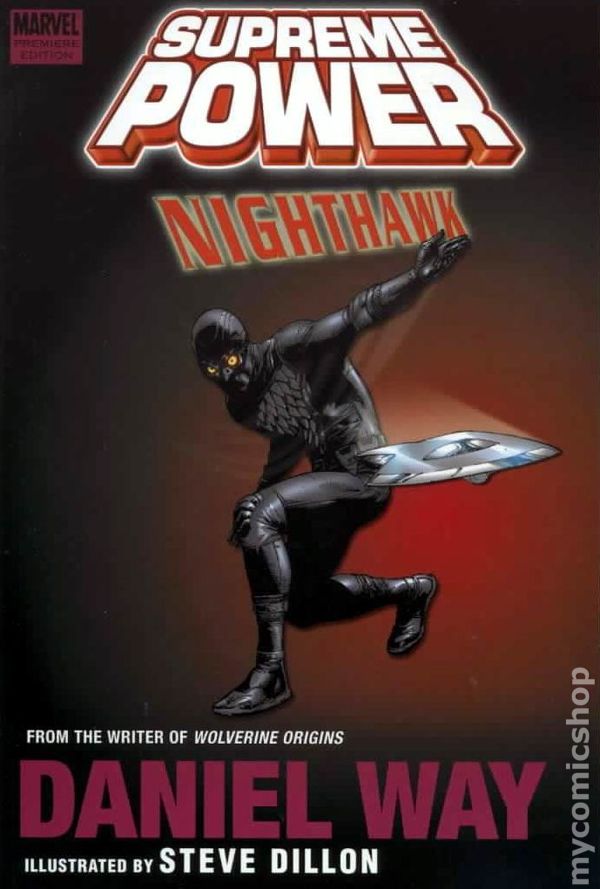
Supreme Power: Nighthawk, Daniel Way

"As a boy, Kyle Richmond - the man who would one day become Nighthawk - witnessed the senseless murder of his parents. There was no reason for their deaths, no provocation - they were just simply in the wrong place at the wrong time. It was a traumatic event that has left him scarred for life - and turned him into a hero more feared than the criminals he polices. Now, it's happening again... but on a much larger scale. The people of Chicago - men, women and children - are dying in the streets, victims of a monster whose thirst for slaughter cannot be quenched, whose soul is a bottomless void and whose scars run even deeper than Nighthawk's. Long ago, Kyle Richmond looked into the face of madness - now, it's looking back at him. And it's flashing a killer smile. Collects Supreme Power: Nighthawk #1-6."


The main draw of this is the Steve Dillon art, a guy who is the go to for obscenely sterile violence (read Preacher or The Punisher, and be amazed at the hurt that can be drawn from a guy who doesn't detail his work in any way). Sticking him on an alternative take on Batman vs The Joker is a stoke of genius  and it helps that it's written by Daniel Way, the guy behind some of the best of Deadpool, and another man who's very at home with impressive levels of serious violence.

So there is a competent team in place, and they certainly don't disappoint. Whilst it's an inconsequential tale its nice to see a story that doesn't take its subject matter very seriously. Nighthawk is a character that's rife for this kid of treatment - as a Batman parody he doesn't really work, because he's too in-jokey for the reader. His entire set up in the Supreme Power reality is that of an amoral Billionaire who only intervenes in those cases where he can help black people, and sees everything through a prism of perceived racism.

It's basically taking the concept of Batman as a protector of the weak and turning it to Batman being the protector of some of the weak, the few that are like him, a concept that just makes him ridiculous.

Still, it's amusing to see him breat the crap out of racists and bullies, and his lack of limits make for a refreshing solution when he does confront the joker analogue who is murdering anyone and everyone across Chicago. There's little of substance there, but it works, and it's a nice addition to the Supreme Power universe.

Also Try:
Scott Snyder, Death of the Family
J. Michale Straczynski, Supreme Power
Daniel Way, Thunderbolts
Garth Ennis, Preacher

Supreme Power; High Command, J Michael Straczynski

"In their first adventure as a team, Hyperion, Blur and Nighthawk--the newly formed Squadron--have a long-overdue showdown with the superpowered serial killer who's been terrorizing the nation! But will they live long enough to stop him? Plus: What does the most powerful being on the planet do when he finds out he's been manipulated, and that his whole life is practically a lie? how will Hyperiod react, and what does that mean for the rest of humanity--and the government that's organized these deceitful machinations?"


The Supreme Power books are another of those series that I remember being really excellent when I first read them years ago, and which on a second reading have got both better and slightly worse.

That's all down to the core concept. Reading Supreme Power for the first time, I didn't catch the fact that it's a pastiche of the Justice League, a concept that's so stunningly obvious that only the fact that I didn't read much in the way of DC when I first started reading comics and so didn't catch analogies to Green Lantern and Aquaman, who at that point were still obscure enough to not be a superhero I would recognise.

On reapproaching the series then there's al ot of extra depth in the story of Superman in the real world, a concept that's been done to death, but rarely so comprehensively or as well as it is here. The genius of Straczynski is in linking everything to Superman (Hyperion) arriving on earth - the emergence of a Godlike figure leads to the creation or revelation of others.

It's easy to draw parralels from this to the rise of cape comics in general, as Superman was one of the first comics to move away from the pulp action hero genre into full superheroics, and can be seen as the first great comic run, even if it wasn't the first superhero comic

Every other hero (and villain) stemming from the emergence of Hyperion is a nice way of representing this, and it adds an extra layer to a character who is at his best when inspiring others to greatness. It's further layered on by the fact that the majority of the action of humans in the comic are resolutely imperfect - they aren't inspired to do better, but to more horrendous actions.

It's a wonderful flip on the Superman mythos which usually just involves Superman 'turning' bad, either in reaction to tragedy - as in Whatever Happened to the Man of Tomorrow, or Injustice: Gods Among Us - or simply being raised wrong - like in Red Son. The alternate version here is still a man with a strong moral compass, who still inspires, albeit one who is confused and lost, abandoned and persecuted by the Government that raised him. He is, in fact, a man who is raised without truth, or justice - the realpolitik American Way.

Anyway, this is a series that by this point is twelve issues in and has just had the first few team-ups between the Justice League analogues. It's a Superman book, in all but name, and anyone expecting much in the way of a team will be disappointed. Of the six superheroes shown only three ever interact at a time, and mainly for a few pages. In nearly every case they fight.

That's one of the issues - it's a team up book that doesn't contain much in the way of a team up. The second is that the last ten years have seen so many edgier, darker takes on the high-profile superteams of the Marvel and DC universe that it's hard to make an argument for this one more than any other. Millar's Ultimates, Ellis's The Authority and Planetary, even Garth Ennis on The Boys - all deconstructed the idea of superheroes and rewrote the rules of what superheroes could and couldn't do.

This is hardly pushing the envelope in terms of this; it's a realistic take on Superheroics, putting it into a context of what would happen rather than asking how far we can push these characters into darker pursuits.

Still, Supreme Power is well worth picking up if you like your comics grand in vision. It's a book that takes a while to take off, but when it does, it soars.

Also Try:
Mark Millar, The Ultimates
Grant Morrison, All Star Superman
Warren Ellis, The Authority

Saturday, April 6, 2013

X-Men Legacy; Sins of the Father: Mike Carey

As Professor X searches to fill the gaps in his memory, someone else searches for him. His psyche rebuilt from the ground up after he suffered a near-fatal gunshot wound, the former leader of the X-Men has set out to rediscover his forgotten past. But when one of his former students, Gambit, tracks him down, he brings news of an assassination plot centering on Xavier, among others. The reason for the plan is obscure, but all the targets share a history with the recently deceased X-Men foe Mr. Sinister. Though he no longer walks the earth, the man once known as Nathaniel Milbury has managed to reach beyond the grave, by way of a plot conceived decades ago but only coming into effect upon his death. In the process of defending Professor Xavier, Gambit is forced into an uneasy alliance with one of the X-Men's oldest foes. Can they put their differences aside long enough to uncover the truth about Sinister's plot and the attempts on Xavier's life? This volume also includes a story by X-Men co-creator Stan Lee, in which "The Man" himself explores the relationship between Xavier and his sometime foe, sometime friend Magneto. Plus: a recently uncovered X-Men story by classic creators Roger Stern and Dave Cockrum!

I am a huge fan of the X-Men, but a surprisingly poorly read one - I have a lot of the early Claremont run, and am picking up a lot of the current Bendis run, but I like to pick up random back issues where I can to supplement my knowledge, and I am a sucker for anything featuring Cyclops, especially post-House of M. So I picked this up on the basis of Cyclops on the cover, only to find it was all about Charles Xavier.

Sure, Cyclops shows up for a few issues at the end so that he can have a heart-to-heart with Xavier, but it's mainly about the Professor, Gambit and Sebastian Shaw teaming up to take down Mr. Sinister. Of those characters, I actually only like the two bad guys, so this wasn't a huge draw.

It does however feature a back up in which Magenton and Professor X kidnap Stan Lee to ask him to stop making them fight as they want a holiday. That one is excellent.

Also Try:
Joss Whedon, Astonishing X-Men
Brian Michael Bendis, All New X-Men, Uncanny X-Men
Chris Claremont, Uncanny X-Men
Grant M|orrison, New X-Men

Saturday, March 23, 2013

Heroes for Hire: Control, Dan Abnett and Andy Lanning

In the aftermath of SHADOWLAND, Marvel's greatest street heroes - Punisher, Moon Knight, Shroud, Elektra, Paladin, Silver Sable, Ghost Rider, Iron Fist, Falcon, Misty Knight and more - leap into one all-new adventure! Who has brought together these dangerous loners into one fighting force? How is this network different from all other teams? Who is their first target, and what mysteries await them? Discover the answers and enter the action on Marvel's mean streets - courtesy of fan-favorite writers Dan Abnett and Andy Lanning (THE THANOS IMPERATIVE, PUNISHER: YEAR ONE), and artist Brad Walker (GUARDIANS OF THE GALAXY)! Collecting HEROES FOR HIRE (2011) #1-5 and material from X-MEN: CURSE OF THE MUTANTS SPOTLIGHT.


Heroes for Hire is a title that really should get more love from me than it does. I've really enjoyed the few issues I have picked up (mainly for its spotlighting of third or fourth tier heroes like Misty Knight and Paladin) but, much like Defenders, it's never quite grabbed me enough to make it an instant buy.

Still, Abnett and Lanning have spent the last decade knocking Marvel's cosmic books out of the park (the upcoming Guardian's of the Galaxy film will be happening 100% because of their stories), so their name attached to a run on Heroes for Hire was enough for me to part with my money for the book, albeit with pretty low expectations going in.

I was pretty pleasantly surprised with it overall. The feel is very much in the Defenders realm of low profile capes kicking butt, but the weekly introduction of a different character for each situation (Elektra to take out high end drug dealers, Ghost Rider to break up occult gun-running, Moon Knight to prevent people smuggling) and the 'Control' sections with Misty Knight give it a real 'Global Frequency' style feel, which works remarkably well.

The stand out star of this is Moon Knight, a character based on Batman, who really lives up to his fan status as a heavier hitter than he's given credit. His page time is the highlight of these pages, especially under Brad Walker, the first artist on the book.

Whilst most of the page layouts are fairly pedestrian, Walker seems to light up when given the chance to break free. Marc Spector's mental troubles lend themselves well to the more chaotic pages here; his introduction, leaping through the page, is the first moment when the book finds its feet after a chase sequence involving Falcon and Black Widow that sorely lacked dynamism. His showdown with a raptor later in is a wondeful example of page economy (single splash page, two follow up panels of outcome, and voice over text boxes to tell the story).

Better for it's inclusion of multiple characters, this is still, ultimately Misty's tale, and it's one which brings in original hero for hire Iron Fist by the end. It doesn't seem to have lasted long (Heroes for Hire never does), but it's worth reading if you can find it, at least until Moon Knight gets his own ongoing.

Also Try:
Keith Giffen, Defenders: Indefesible
Gail Simone, Birds of Prey
Warren Ellis, Global Frequency
Grant Morrison, Batman, Inc

Sunday, February 24, 2013

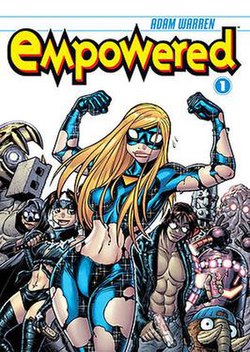
Empowered Volume 1, Adam Warren

"Not only is costumed crimefighter "Empowered" saddled with a less-than-ideal superhero name, but she wears a skintight and cruelly revealing "supersuit" that only magnifies her body-image insecurities. Worse yet, the suit's unreliable powers are prone to failure, repeatedly leaving her in appallingly distressing situations . . . and giving her a shameful reputation as the lamest "cape" in the masks-and-tights business. Nonetheless, she pluckily braves the ordeals of her bottom-rung superheroic life with the help of her "thugalicious" boyfriend (and former Witless Minion) and her hard-drinking ninja girlfriend, not to mention the supervillainous advice from the caged alien demonlord watching DVDs from atop her coffee table . . . 

From Adam Warren comes Empowered, a butt-kicking, bootylicious superhero lampoon that raises the bar for long-john lust and low-brow laughs. Remove all previous notions of superhero entertainment from your puny mind . . . and prepare to be Empowered!"


Empowered is an English language superhero Manga (Warren describes it as being drawn in a manner that will put off American comics readers, and about a subject that will put off Asian Manga readers) that grew out of commisioned sketches of 'cheesecake' superheroines - softcore pictures of helpless women tied up.

So it doesn't really have much in the way of feminist credentials. It wears its interests on its sleeve. It's very clearly a T'n'A book, with the title character spending the majority of the book either naked or chained up.

And yet, for all its standing as a ridiculously uncomfortable public read, Empowered has an incredibly sweet heart, that elevates it beyond gratuitous swimsuit shots, and a wicked sense of humour that lashes out at the very stories it ends up parodying.

Empowered is a woman with serious body image issues, abilities that stem skintight suit that falls apart in combat and can't be covered up without losing power, and a group of villains who are quicker to capture and tie up the superheroes than actually kill them. It's a combination that leads to a lead character who is extremely awkward and unsure of herself - essentially the Marvel method of Superhero creation updated to the modern day.

With the majority of the story focusing on her relationships with ex-minion Thug Boy, and best friend (and ninja) Ninjette, we get a masterclass in creating character.

But the big sell is Willy Pete, a character who appears for less than 5 pages but who steals the book out from under the heroes. Willy Pete (code for White Phosphorous) is the kind of villain who can only appear in creator owned works, and every single panel he appears in is a horror show. For a villain with almost no page time at all he leaves an indelible mark on the book, both in the trauma he inflicts on Thug Boy and the way he sears himself across the mind of the reader.

If I pick up any of the later books, it will be to see what happens with him. The other good bits will just be a great bonus.

Also Try:
Birds of Prey, Gail Simone
She-Hulk: Single Green Female, Dan Slott
Captain Marvel, Kelly Sue DeConnick
Invincible, Robert Kirkman

Exiles: Point of No Return, Jeff Parker

"Heroes are being pulled out of the worlds they know - The Beast. The Witch. Panther. Forge. Polaris. All find themselves in a place out of time with a new mission in life. But something seems to have shifted in the mechanics of the universe, and things may not be quite what we remember. But one thing we know for certain - BLINK is BACK! Collects Exiles #1-5."


Exiles is one of my favourite series, a What-If worlds tour between different realities starring alternate versions of classic X-Men and Avengers righting the course of history in different dimensions. It's a wonderful concept, designed to appeal to those who love the history of the Marvel Universe as much as a casual comics or X-Men fan. The original series, running for 100 issues, is one that I collect to this day, picking up the (many) trade paperbacks whenever I can.

It has an easy appeal to explain: big storylines that were ended by the heroes are taken to their logical extreme. It's a series where writers can do whatever they want - kill all the heroes, let the villains win, destroy all mutants, whatever they want! From realities where Captain America became a vampire (in that reality he hadn't got a collar on when Baron Blood attacked him) to ones where Wolverine killed everyone (he was never rescued from Hydra brainwashing) or Professor X is a supervillain, it served as a replacement for the off-and-on again What If?, or DC's Elseworlds titles.

Whilst it declined in quality when Chris Claremont (and his beloved Psylocke) joined, this first volume of Exiles (2), is a real return to form. So of course, it got cancelled after 6 issues, meaning we never got to see the planned worlds of Magic or Savage Land World storylines.

Split into two basic stories, with the first returning for the final few issues, this see's a new team of Exiles jaunting to realities where all mutants united under Magneto on Genosha, and one where a Cerebro-Ultron programme share retasked all robots to destroy humanity.

The art and story are both excellent, and if you're a fan of reality hopping tales, Marvel history, or just great comics it's really worth picking up.

Also try:
Exiles, Judd Winick

What If?, Various Writers
Superman: Red Son, Mark Millar
Marvel Zombies, Robert Kirkman

Thursday, February 21, 2013

Batman and Robin; Dark Knight, White Knight, Paul Cornell

"The Dark Knight and the Boy Wonder face multiple threats and villains new and old, including the mysterious White Knight, the villain Absence and the renegade Robin of the past, Jason Todd--in stories written by creators Paul Cornell (ACTION COMICS, "Doctor Who"), Pete Tomasi (GREEN LANTERN CORPS, NIGHTWING) and Judd Winick (BRIGHTEST DAY: GENERATION LOST, BATMAN)"


The last volume of pre-reboot Batman and Robin is a weird book to evaluate. It's an unoffensive read - a very average, middle of the road Batman story, punctuated with a couple of really nice moments.

The real problem with it though is that it's essentially filler, coming off the back of a great Grant Morrison run, part of his epic Batman run that chronicled the adventures of Dick Grayson and Damian Wayne. It was a fan favourite, and it featured some truly excellent arcs.

So this has a lot to live up to, and its position in between the tail end of this run and the start of the New 52 of DC titles means that it's essentially three short stories with little impact or depth. The worst offender of this is a Jason Todd story that closes out the book (and the series). It's an entertaining rehash of Rorschach in prison from Watchmen, which ends with someone breaking him out of jail. Problem being that this 'someone' isn't ever mentioned, so there's no motive, no resolution - nothing!

The whole thing is extremely inconsequential, and you're better off picking up the earlier (or later) books instead. When even Paul Cornell can't save your book, it's time to move on.

Also Try:
Watchmen, Alan Moore
Batman and Robin, Grant Morrison
Batman, Scott Snyder
Knight and Squire, Paul Cornell

Friday, February 8, 2013

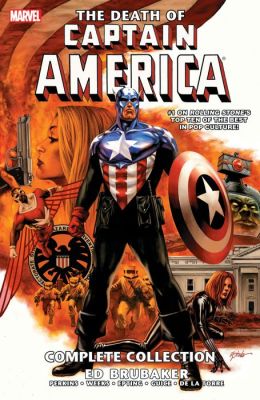
Death of Captain America: The Complete Collection, Ed Brubaker

"Captain America was a hero to millions, an inspiration to America's armed services and the representative of his nation's greatest ideals. He lived for his country - and now, he has given his last final measure for the nation he loved. In the aftermath of the superhuman Civil War, Captain America was shot down in cold blood. Those closest to him must come to terms with his death, finding new roles for themselves that will shock readers. Collecting: Captain America (2005) 22-42, Winter Soldier: Winter Kills"


This one is a mixture of stuff that I've read before plus some that I haven't culminating in my last reviewed book (Captain America Reborn), this is pretty much what you can guarantee from a Brubaker Cap book. It's well told, complex and hugely enjoyable, with great art and plotting that rewards a careful reader.

Following the return of the Winter Soldier, this book collects the death of Captain America after Civil War through to the point of his return. It's an interesting period in the life of the book, as for much of the time it's a book wholly lacking in Captain America. Bucky's step up from Winter Soldier to new Cap, juggling his anger about Steve's death, the guilt of his own crimes and the desire to kick Tony Stark in his shiny metal behind.

Split between a number of artists over the course of 21 issues, there's a consistently high quality, whether illustrating wet World War II missions, brutal one-on-one combat or giant brawls.

It's hard to talk about Captain America under Brubaker without at least mentioning the tone of the book.
This is essentially SHIELD book, pretty much an even split between Agent 13, Nick Fury and Bucky (with very little Captain America-ing). It's not until the last few issues that Bucky takes up the shield to take the fight to the Red Skull.

But it's the maturity of the work that's the biggest difference. This isn't the Red Skull of Uncanny Avengers, using a telepathic brain to control the world. This is a Red Skull who mainpulates stock markets, crashes the American Economy, bribes senators and congressmen and engineers a shoot-out between law enforcement and protesters.

The Red Skull is an incredibly Political villain (most of Captain America's enemies are), and it's nice to see this side of him played up, just as it was in Geoff Johns' Avengers: Red Zone. He works best as the anti-Cap, and positioning him as the architect of the actual threats to real people is a neat touch. It also means Bucky has to face the recession, something he can't punch in the face.

In amongst all that smart stuff though we still get some great action sequences, notably the takedown of a SHIELD team by Bucky's detached arm, and his first pistol packing fight with AIM.

Again, not a great starting point (go back and pick up Winter Soldier), but brilliant if you love Captain America, or comics.

Also Try:
Geoff Johns, Avengers; Red Zone
Rick Remender, Uncanny Avengers
Mark Millar, Old Man Logan


Monday, February 4, 2013

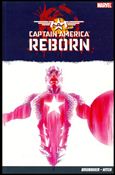
Captain America Reborn, Brubaker


"Steve Rogers was Captain America, the world's greatest hero since the days of WWII, a champion for all citizens of the world. One fateful day, the Sentinel of Liberty was struck down - and how the American Dream died that day. But now there may be a way to bring back the world's greatest hero! Collects Captain America #600 and Captain America: Reborn #1-5."


The sad thing about Captain America Reborn is that it was released so close to that other superhero battles through time to return from the dead epic, Batman: The Return of Bruce Wayne. They're totally incomparable, mostly because Batman is utterly insane (although CAR takes a good stab at equalling it). The thing that's always great to read Brubaker on Cap for is that he grounds the character in a more recognisable world than most. Here, that's a problem: it's somehow too serious (I hesitate to say Realistic) a setting for a tale about a man unhinged in time, whose fate is controlled by the brain of his worst enemy, in the body of a robot.

When I say that this ends with Captain America (reborn) and his sidekick, (also) Captain America, fighting a giant robot Nazi on the steps of the Lincoln memorial, it's because I want you to understand that this is a pretty crazy book. But it never really embraces that concept. The best 'thrown through time' stories can go anywhere, but this sticks to Cap's life from WWII through to the present - hardly boring, but not actually all that bizarre by the standards of most Marvel comics.

The main thing about Captain America, and the reason why Reborn works less well than Bruce Wayne does, is that he's better as a symbol than an actual character. One of the most interesting things about the Brubaker Captain America books is that Captain America (the person) transitions from a character to an ideal. Cap (the person) is constantly held up as Captain America (the myth), until his death creates a void that is filled by Bucky Barnes, former sidekick and now the new Captain America.

So the previous stories have been the passing of the torch, just as how Batman has Dick Grayson take up the mantle of Bruce Wayne. But what always felt like a place holding for Batman's inevitable return actually felt natural in Captain America. It felt right that Cap's sacrifice should inspire his friend to become more than just a man.

And in undoing that it lessens Bucky's growth. He's no longer the man struggling to fill the shoes of his mentor. He's the other Captain America. The less good one.

Cap should be an ideal, an icon. He works better that way. It's one of the many reasons why Civil War was so ill conceived. Pitting the very spirit of America ( Marvel's Superman, the embodiment of Truth, Justice and the American Way, who inspires all around him to strive harder) against an alcoholic with a metal suit ran into the brick wall that even in a post-9/11 world fans didn't want to support the 'realism' of Iron Man over the 'idealism' of Captain America.

In a war between the humble patriotism of the past and the hardheaded pragmatism of the present, the only side the audience would ever choose is the one that's less like their own. Why ruin your escapist fantasy with a slice of real life?

The story itself is good, and Brubaker has a handle on all of the characters that works well. The opening #600 issue is by far the best part (it features Rikki Barnes!) but nobody draws people fighting giants as well as Bryan Hitch.

This is worth checking out, but try Batman first. That book is AMAZING!

Also Try:
Batman; The Return of Bruce Wayne, Grant Morrison
The Ultimates, Mark Millar
Thunderbolts: The Geat Escape, Jeff Parker


Wednesday, January 23, 2013

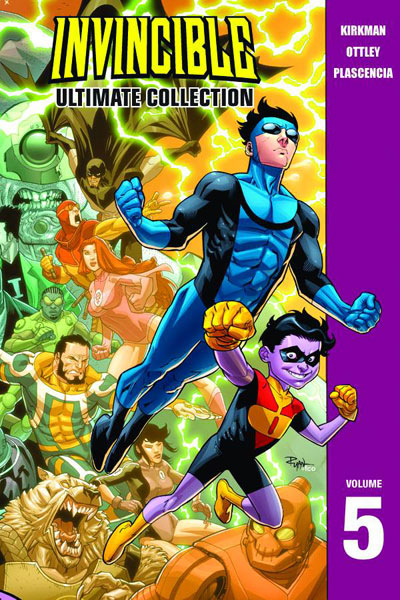
Invincible Ultimate Collection Volume 5: Robert Kirkman

"Witness Invincible's transition from new hero just starting out to an established superhero! This volume collects Invincible's confrontation with Cecil Steadman, the return of the Reanimen, and the beginning of a bold, new era for Invincible!"


Read back to back with Volume 4 (the way all long running comic series should be), Volume 5 of the Invincible Ultimate Collection rewrites the tone of the series (again) to place Invincible as the enemy of the Government sponsored Global Defence Agency.

Whilst it still feels like it's setting up events for later volumes (the Invincible Wars, Conquest and the Viltrumite War all take place in the next two books, alongside another Sequid invasion) this definitely contains some great issues - the Reanimen versus the Guardians of the Globe, and Invincible against Powerplex in particular are two very different stories with very different emotional outcomes.

Whilst Ottley isn't given anything on the scale of the Martian warship or aerial cityscape from Volume 4 to draw his pencilling continues to evolve. An especial highlight of the Ultimate Collections is the wealth of extra's included at the end, from scripts, cover breakdowns and pre-inked panels to convention requests and character designs. These serve to demonstrate just how much work is put into the simplest of panels and give the reader some idea of how the book is constructed.

Having read both of these volumes as individual comics years ago it was a pleasant surprise to realise I remembered almost nothing of the story contained in this volume and was able to get as caught up in the plot twists as if I were a new reader. Invincible remains one of my favourite comics, and with Volume 8 out later this year one that still has a lot to offer those interested in reading one of the most interesting and original superhero comics around!

Also Try:
Robert Kirkman, The Walking Dead
Allan Heinberg and Jim Cheung, Young Avengers
Peter David, Young Justice

Invincible Ultimate Collection Volume 4: Robert Kirkman

"Witness Invincible's transition from new hero just starting out to an established superhero! This volume collects Invincible's violent battle with the villainous Reanimen, the invasion attempt by the Sequids from Mars, and the introduction of the Viltrumite agent, Anissa."


Invincible, Robert Kirkman's long running cape comic, has established itself as one of the best superhero comics around, and it's easy to see why in this book.

The joy of Invincible is how vast the universe feels. The action moves from the Ocean floor to the furthest reaches of Space, and it's as diverse a world as any in comics. From Atom Eve in Africa to Mark's life on campus at university each character has a distinct identity and presence in the book which sets it apart from other Image titles, even those in the same shared universe.

Kirkman distils the very essence of cape comics into a single epic story. By this point many of the threats and adversaries that Mark faces have been established - the Mauler Twins, Lizard League, Sequids and Viltrumites all show up. From the start of the series Invincible felt like a comic with a wider reach, with pre-existing villains and a very different status quo.

By this point the set up from previous arcs has begun to pay-off and storylines like Allen seeking out Omniman, or Oliver's burgeoning powers become big moments. In a book where every issue feels like an event, where there are consequences and repercussions for every action, this is a final calm before the storm of the next 30-40 issues.

If you've never read Invincible this isn't a great place to start - the downside of the grand scale worldbuilding is that it presupposes that you know who's who. It won't be incomprehensible to new readers, but you're better off starting at the beginning. It's a journey that's worth it, and it'll make the heroics, the sacrifices and the pay-offs all the sweeter.

Also Try:
Brian Michale Bendis, Ultimate Spider-Man
Robert Kirkman, Tech Jacket
Brian K. Vaughan, Runaways