Saturday, June 21, 2014

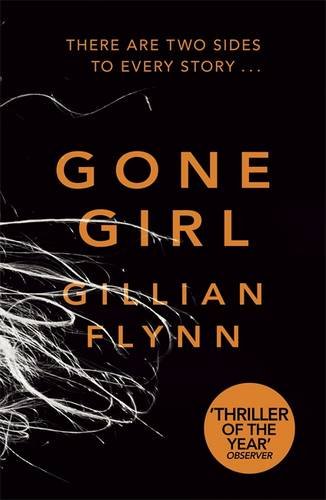
Gone Girl, Gillian Flynn

"THE ADDICTIVE No.1 BESTSELLER THAT EVERYONE IS TALKING ABOUT


Who are you?

What have we done to each other?

These are the questions Nick Dunne finds himself asking on the morning of his fifth wedding anniversary, when his wife Amy suddenly disappears. The police suspect Nick. Amy's friends reveal that she was afraid of him, that she kept secrets from him. He swears it isn't true. A police examination of his computer shows strange searches. He says they weren't made by him. And then there are the persistent calls on his mobile phone. So what really did happen to Nick's beautiful wife?"


A smash hit literary juggernaut, Gone Girl is the ultra-successful 2012 boook-club thriller that runs 200 pages too long and reads like two separate books unwillingly pounded into one unsatisfyingly predictable zzzz-fest.

If you havem't read Gone Girl (you're lucky), and want to (you're silly), look away now, because there will be spoilers.

The story of the disappearance of Nick Dunne's wife, Amy (the titular 'Gone Girl') and the subsequent investigation into him, framed around his account of the aftermath of Amy vanishing and her diary recounting their relationship, the idea is to create a split narrative in which nobody can be trusted.

Unfortunately it's slightly undermined by two things. Firstly, Nick is initially written to be utterly dreadful; a man who cheats on his perfect, chaste and beautiful wife, can barely be bothered with her or anyone else, and through his generally over-the-top stupidity manages to turn you against him from the start. His main character traits read like the first draft of the worst CV; he lies to stay out of trouble, and overcompensates in awkward situations by acting disinterested and hiding emotion. Two flaws that are fine by themselves but which signal a monstrous lack of cooperation in a murder investigation.

In the postscript, Gillian Flynn, the author, hand-waves away the negatives surrounding the character, suggesting he's not that bad a guy. Unfortunately, having spent the first half of the book doing everything possible to suggest that Nick isn't just a bit inept, but outright capable of murdering his Mary Sue wife, it's kind of hard to row that back round in order to create sympathy for him come the, not at all shocking, third act twist that he didn't kill her.

Not that you'll care. If you've been paying attention you're probably already willing to take a claw hammer to Nick's smug, stupid head whilst society cheers you on and films it on their phones to show their kids that they were there the day this asshole got his, clapping and whooping, and when it comes time to sentence you the Judge just winks and lets you off with a warning because, really, we all wanted to do that, didn't we. It's just that you did it. If this were a choose your own adventure book you would win by cracking Nick open like a pinata; a crappy, loser cheat husband full of sweets and booze and rage.

And here comes the second problem, because having created a character so unloveable that every other person in the book, including his own twin sister, not to mention probably most of the reading audience, accepts could straight up murder his flawless wife, Flynn then has to redeem him. You need to root for him, hope that he'll be cleared and want to continue reading about a man who's main contribution to the plot up to this point has been harassing old friends of Amy's and hiding evidence.

Now, in the hands of a good writer, this could go one of two ways. Nick could continue to be flawed, but could start to show some positive traits; he could cooperate with the police, at the very least. Or, alternatively, you could create a world in which Nick, an asshole, is not the worst person in the relationship.

Guess which one is going to happen.

Because Gone Girl, it turns out, isn't actually a thriller at all. It's a horror. I married a psychopath. Amy, perfect, loveable Amy, turns out to have faked her own death to punish Nick, which I think is supposed to be bad, but by this point I'm quite happy to see Nick get a hard time. Until it turns out that no, Amy is going to go on with enough until Nick is convicted of her murder so she can see him executed, because he cheated on her.

It should be noted that you'll have probably called this sequence of events at about the time it's revealed that Nick has had a mistress for the last year or so. Amy is written, in both narratives, as too perfect, and Nick as too much of a baddy, for the plot not to undo itself by reversing our preconceptions.

Our two protagonists people  Who to root for? Do you cheer on the guy who straight-up drove his wife to the point of supervillainy, or the woman who decides that murdering her irritating husband is less embarassing than filing for divorce.

Trying to reboot Nick's character at this point requires some Lazarusian levels of personality resurrection. He isn't easy to redeem, so Flynn decides to just not bother. Instead, we get in a final sequence in which a full blown psychopath who has spent years setting up the perfect crime comes home, because Nick asks her to and she got kind of bored and made some bad decisions whilst hiding out, or something. Oh, also she killed someone else, but they can't pin that on her because the books finishing now and so he sticks around and she gets pregnant to keep him there.

Jeez, these two deserve one another, if only so that only two people are unhappy instead of four.

Also Try:
The Prince, Machiavelli
A Song of Ice and Fire (but just the Joffrey bits), George R. R. Martin
Silence of the Lambs, Robert Harris
Lamb to the Slaughter, Roald Dahl


You Are Awful (But I Like You); Travels Through Unloved Britain, Tim Moore

"Would you cheer if they sent you to Coventry? Could you stick up for Stoke or big-up Bracknell?Can you handle the thrill of Rhyl, the heaven of Hull or the mirth of Tydfil?


In You are Awful, Tim Moore drives his Austin Maestro round all the places on our beloved island that nobody wants to go to - our most miserable towns, shonkiest hotels, scariest pubs, and silliest sea zoos...

But as the soggy, decrepit quest unfolds he finds himself oddly smitten, and the result is a rousing, nostalgic celebration of mad, bad But I Like You Britain."


A sort of 'Playing the Moldovans at Tennis' of Britain, this is a poor-mans version of Bill Bryson's 'Notes From A Small Island'; written as comedy rather than actual travelogue and playing up that uniquely British thing of being all too passionate about something really, really shit.

Basically, this is these book reviews, in the Wonder Twin's style form of a book about Britain.

Comedy books tend to be hit or miss, and comedy travel guides are dime a dozen. I read it. I can't remember much of it. I learnt one or two interesting things, but, really, crappy towns are much the same. One bad hotel, or city centre, or museum isn't that dissimilar to another, and it's hard to sustain jokes or come up with new ones when you've only got one target.

The bit about Hull is excellent though.

Not awful, I liked it, but there's better out there.

Also Try:
Playing the Moldovans at Tennis, Tony Hawks
Notes From A Small Island, Bill Bryson
Watching the English, Kate Fox


Friday, March 7, 2014

Excalibur Visionaries - Warren Ellis Vol. 3, Warren Ellis

"Nightcrawler! Colossus! Shadowcat! Wolfsbane! Captain Britain! Lockheed! Based on Muir Island, Excalibur has become Europe's most famous team of super heroes; now, they face their deadliest threat yet! The Hellfire Club has infiltrated the British government, and they've got a powerful demon at their beck and call! Plus: Pete Wisdom and Kitty Pryde track a serial killer! Don't miss some of Warren Ellis' finest work!"


Way back when I reviewed Volume 1 and 2 of these Warren Ellis collections of eXcalibur, I remarked that I found them to be better but duller than the straight Americanism's of the mainline X-Men.

High vs Low Culture is not a debate I care to wade into too much, especially insofar as comics are concerned. The culture is already niche enough that a schism between those who think 'Maus' is an incredible work of visionary genius, a heartfelt and nuanced portrayal of the Nazi regime, and those who prefer a vision of 1930s Germany that features 100% more American super-soldiers straight up punching Hitler on the front cover. There are a lot of great 'high' comics, where mainstream or indy, and a lot of terrible 'high' comics, and that's also true of 'low' comics.

And just like with films, some of the worst comics are also the most entertaining. Go read comicsalliance deconstructing Batman: Odyssey ( http://comicsalliance.com/batman-odyssey-review-commentary-part-4-neal-adams/) or anything by Chris Sims on Tarot: Witch of the Black Rose, and you'll find awful comics that are still entertaining. Likewise, some of the best films and comics are ... well, they're pretty boring.

Warren Ellis is fantastic. Warren Ellis can do little wrong in my book. Warren Ellis is an excellent writer, and these are, aesthetically, intellectually, classically, great comics. There is nothing functionally wrong with them. They just don't do it for me.

I read them and they leave me empty, I feel ... nothing. I leafed through 'Red Rover Charlie' in a comic store today, and that almost made me cry then and there. It features art from someone described by the staff at Nostalgia and Comics as "an artist who can only draw animals. Well, dogs. Well, three specific dogs" and yet it has had more emotional impact from a 3 minute glance, and 12 pages of story than this whole volume featuring a half dozen characters I have invested far too much time in.

It is a well made comic. But it isn't a great one.

Its roughly the same situation I talked about in dissecting the previous two volumes, but in doing so I kind of left them to one side. They disappointed me, so I didn't analyse them in depth. They were a slog, and writing about something that's that much effort to read is a chore, so I didn't. But now I'm going to try and analyse exactly why these comics do not work.

The key thing that needs to be understood is that eXcalibur is "the English X-Men". Based out of Muir Island, featuring a cast of established X-Men (Nightcrawler, Colossus, Kitty Pryde) and their Marvel UK compatriots (Captain Britain, Meggan, Wolfsbane and Pete Wisdom), they protect Britain from threats both mutant and magical.

The conveniently tight focus on the New York scene that allowed for easy cameo appearances, cross-overs and world building between titles within Marvel as a whole leaves a lot of room for heroes operating outside of that - there's a whole lot more of the planet than the areas of New York, or, at a stretch San Francisco the X-Men usually operate in.

So a British team has been, off-and-on, a near constant for years, and the influx of young British creators into the American comics scene meant there were plenty of people willing to tell stories set in London, rather than Manhattan.

But the problem with any spin-off is that you are assuming that there's enough there to sustain the interest when divorced from the original source material, in this case; the X-Men.

Excalibur, at least under Ellis, are not. But it isn't like there's much chance of it carving out its own identity, when three of the main cast are core X-Men team members. Colossus and Nightcrawler appeared in the Second Genesis relaunch, and Kitty was the first new member introduced, in Uncanny X-Men #129, 35 issues later. So these guys have been here since, nearly, the very beginning, and they naturally overshadow even established characters like Moira, Brian and Meggan.

Considering that the cast is rounded out by 'a guy who will grow up to be Ahab' and Douglock, you can see why they were bound to be the most focussed upon.

Making ex-X-Men the most popular and visible characters in a book that's meant to be demonstrating its independence from the X-Men is a bit of a bum start then. It's resolutely not written as an X-Men book. It's 'darker and grittier' in the sense that the phrase 'darker and grittier' was originally intended for. People smoke, die, kill, sleep together, swear and act like humans. They usually do this without needing to remind the reader how dark and gritty this all is. They're mature, without being childishly so. It's not Torchwood. And it's not the X-Men, or at least not the X-Men in the way that someone picking up an issue which prominently displays three X-Men on the cover might expect.

Even ignoring that though, there's the secondary problem that throughout the book the real X-Men keep showing up. It's like they forgot this wasn't their book, so at least once an issue they appear to explain what's happening in New York (it's Onslaught).

A little sidenote; this is, alongside Thunderbolts, the best depiction of the world post-Onslaught. The very first thing that the US Government does, following the deaths of 90% of the worlds non-mutant superheroes, is send agents to warn eXcalibur not to come to the US, or else they'll be killed. At this point you would think that the authorities would be desperate to get some heroes on-board who can actually fend off the next Kree-Skrull war, or stop a giant planet eater from consuming Earth. But no, instead we get fantastic racism.

It's deliberately played up as a weirdly 'American' thing; the idea that their hysterical reaction to mutants is cultural, but that undermines the whole point of the X-Men, that they protect a world that hates and fears them. They are a positive and benign creation of an age of fear and unreason. These children of the atom aren't the villainous destroyers, but protectors of a society that rejects them. Their sacrifice for people who will never, can never, accept, appreciate and understand them resonated in a society, culture and time where racism, sexism, homophobia were real, and bigotry and fear were (and are) accepted.

Rejecting that in British society, selling it as an American disease, undermines the whole concept of who mutants are and why they need protectors and champions. It creates a cultural void that invalidates the basic need for eXcalibur. And they're left dangling without the core delineation between the roles of mutants and other heroes.

And this really is why I think Ellis' eXcalibur doesn't work and why, for instance, Paul Cornell's Captain Britain does; there isn't enough faith in who these characters are as heroes. There's a point where Brian muses on the fact that compared to how people felt about Captain America, the emotional, patriotic response wasn't the same for him. Contrast that with Cornell's pages of Britain's reaction to Brian sacrificing himself:

"when Captain America died, Americans heard it in an American way:
through the media.
When Captain Britain died, the British felt it in their chests."

(I really wish I could get that page up, because I can't tell you how much I love it. For me, it's the ultimate expression of Britishness; we're a nation learning how to deal with what we've lost. Between that, the Black Knight and Faiza holding the bridge alone, and Captain Britain's return, Cornell's series is stunningly worth reading).

British heroes don't have to just be spies, and magic. They can be bombastic and still be British. They don't have to have the in your face jingosim of the Ultimates, but can still represent Britain, and what it means to be British. And they can be separate from the X-Men and still be compelling.

What they can't be is a sub par X-Men lite, divorced from the reasons behind the X-Men and plonked in a new setting. Or rather they can be that, but it doesn't work, and it just makes me want to go read about how the heroes saved New York by jumping into Onslaught, and were themselves saved by a small child's imagination.

Also Try:
Paul Cornell, Captain Britain and MI13
Chris Claremont, Uncanny X-Men
Warren Ellis, eXcalibur Visionaries Vol. 1 and 2
Warren Ellis, Planetary

Thursday, March 6, 2014

The Irresistable Revolution, Shane Claiborne

"Many of us find ourselves caught somewhere between unbelieving activists and inactive believers. We can write a check to feed starving children or hold signs in the streets and feel like we've made a difference without ever encountering the faces of the suffering masses. In this book, Shane Claiborne describes an authentic faith rooted in belief, action, and love, inviting us into a movement of the Spirit that begins inside each of us and extends into a broken world. Shane's faith led him to dress the wounds of lepers with Mother Teresa, visit families in Iraq amidst bombings, and dump $10,000 in coins and bills on Wall Street to redistribute wealth. Shane lives out this revolution each day in his local neighborhood, an impoverished community in North Philadelphia, by living among the homeless, helping local kids with homework, and "practicing resurrection" in the forgotten places of our world. Shane's message will comfort the disturbed, and disturb the comfortable...but will also invite us into an irresistible revolution. His is a vision for ordinary radicals ready to change the world with little acts of love."


I read this over Christmas, so it's a long time coming, and in the meantime I actually got a chance to meet the author and hear him speak about the book, which is the kind of nice thing that doesn't often happen but which makes any book a little bit better. Even ones that don't need that, because this is a book that has more power and urgency in its shortest sentence that most books do between the first and last page.

It is a polemic in the best sense of the word. If Monbiot's writing stirs up a righteous anger, a head-shaking, secular call to action against the world as it stands, then Claiborne is ushering in a Christian alternative, a politically liberal, Jesus centred movement towards how the world should be.

Boy, is it exciting!

This is the book that I want to tell people about, in the way that when I first became a Christian the gospels felt fresh and unexpected, so now Claibornes explanation of why they felt so different, and why that seems so at odds with what mainstream Christianity is, feels so impactful. I want to tell my secular friends, and my Christian friends, and even people who aren't really my friends about an alternative way, a better way, a simple way.

This is, let's just be clear here, a call to actual, practical revolution. Non violent, non-judgemental, but based around a gospel of love that stands utterly at odds with the politics, economy and culture of the world. A revolution predicated on the idea that loving your enemies means not bombing them, that feeding the hungry and clothing the starving is more important than increasing GDP, and that being "pro-life" doesn't mean moving on when a baby is born.

Taking aim at a culture that anaesthatises the current Western church as well as the wider world, Claiborne's call to lay down arms and move in to the worst neighbourhoods and live with the least well off is startling for its selflessness. Centred around an idea that it's impossible to ignore the homeless guy on a Monday if you really worship a homeless guy on a Sunday, he has sought to live a life loving people and God, from the streets and leprosy colonies of Calcutta, to urban America, to Iraq.

More than just a poverty tourist, short-term missional consumer, or a white saviour, his book creates a narrative of demonstrate the love and compassion of God to the unloved and overlooked, wherever and whoever they are.

For all the lefty, compassionate and unconservative, anti-organised religion people, he's a certified bleeding heart liberal; anti-war, anti-consumerist, proto-anarchist and, yet, Christian.

And to all the Bible believing, saved by faith, seeking, searching, longing, Christians, he's a man who thinks you should probably sell everything everything and give it to the poor if you want to take God's word seriously.

This is a man of apparent contradictions, but one passion. A simpler way of life; a life built up in love; a love first given by God.

Also Try:
http://www.thesimpleway.org/


New X-Men (vol 1 - 3), Grant Morrison

"Sixteen million mutants dead...and that's just the first step in Cassandra Nova's plans. With an army of evolved Sentinels primed for annihilation, Nova will stop at nothing to see every mutant exterminated. Led by Professor Xavier, the X-Men have always sought an end to the ongoing strife between mutants and humans, hoping to one day unite the two species in peaceful coexistence. But the time for dreams is past. Now, their entire existence is under direct attack. Now, it is time for the X-Men to fight."

"Enter the U-Men! When envious humans begin dissecting mutants and grafting their body parts, it's up to the X-Men to stop them! But things at home aren't much better as Cyclops and Jean Grey can't stop fighting, Jean's powers flare out of control, and Professor X's mind is trapped in the body of his comatose evil twin! Introducing the new Angel, and the X-Men have never seen anything like her!"

"As protesters lay siege to the Xavier Institute, mutant mentor Professor X lies in a coma, trapped within the shattered form of his evil twin! Cassandra Nova inhabited Xavier's body and escaped to the starts in the wake of her initial encounter with the X-Men; now, the psionically empowered psychopath is returning to Earth- possessed of the most powerful mutant mind on the planet, and with the might of the Shi'ar Imperium at her back!"


Rather than review these three separately I decided I would do it as one (longer) shake-down, mainly because writing about all three one after another doesn't appeal, but also because Grant Morrison is a writer who rewards those who read everything and actively confuses those who only dip in.

As a result these three books may as well be collected in a single volume, because it's a single story arc: Cassandra Nova achieve consciousness and sets out to destroy the X-Men. Everything else in these is almost incidental.

I actually have all three of these volumes on disc somewhere, from when I first got into comics from scans lent to me by other people, and random trades I found in the library. New X-Men was one of those runs that seemed to totally redefine what I though of a comic as being. It lacks the long term status of Watchmen or Sandman, but was a totally different comic to, say. Morrison's JLA.

In part that's thanks to Quitley's art. Usually acknowledged as a master of expressions (just look at his work on All Star Superman, also with Morrison) here his skills are put to use redefining the X-Men as outsiders; they aren't all attractive, movie star-lite celebrities. This was back to basics mutant-kind; hated-and-feared, barely tolerated and, in the first issue, almost exterminated by Sentinels in an act of mass-genocide.

This entire run is epoch-defining and nothing after it was the same. That gets bandied around a lot, but here Morrison really does try and do something different. Retcons aside, this is the book that destroyed Genosha, killed Magneto and Jean, redeemed Emma, moved Wolverine on from his unrequited love, devolved Beast, and introduced Beak, Angel, Cassandra Nova, John Sublime, the U-Men and Quentin Quire and Xorn. Everything that came after new X-Men was informed by it, from Whedon's Astonishing X-Men run, to 'House of M' and 'Generation Hope'. Even the current Bendis and Aaron runs owe as much to this as Lee, or Claremont.

Just as 'Avengers Disassembled' deconstructed the idea of the Avengers, and launched them in a new direction, so the events of the first few issues of 'E is for Extinction' set the stage for a more military Scott, the nexus around which all X-Men events of the last 15 years have circled.

The breadth of the concepts introduced is equally vast. Secondary mutation turns up for the first time here, as does the idea of being pro-mutation as a fashion statement (for Morrison's 'Magneto Was Right' deconstruction, see the post-AvX 'Cyclops Was Right' fandom, both in universe and from fans, for the logical extension).

The mindscape rescue issue of Professor X in 'Earn Your Wings' is usually picked up on for being a bold and daring departure; a silent issue with only two lines of actual dialogue, delivered on the final page, post-procedure. But the real joy is just how many of these there are, whether it's Xavier taking over the Shi'ar Empire (and especially his fight with Gladiator), or Cyclops killing Ugly John - none of these go down how we expect. Every issue features a departure from the norm, culminating in the psychic episode.

Morrison has many faults, and some of them will be on show later in this series, especially as Xorn develops more of a presence and is later revealed as ..., well, that's complicated actually. But this early on, backed by Quitely and genuinly changing the face of the X-Men, this is a blockbuster run, and a must read.

Incidentally, all of this run can be found in The Works for £4 each. Pick up the first and third books to sample it, the second is (good) filler but not as consequential. I guarantee you a good time.


Also Try:
Joss Whedon, Astonishing X-Men
Brian Michael Bendis, Uncanny X-Men
Brian Wood, X-Men
Chris Claremont, Uncanny X-Men


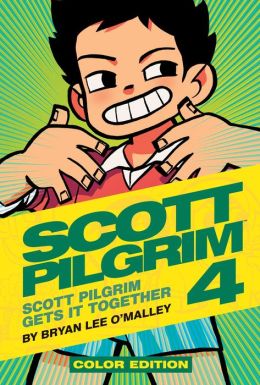
Scott Pilgrim Gets It Together, Bryan Lee O'Malley

"The full-color remastering of the Scott Pilgrim epic continues! It's summertime, but who can relax? Scott's relationship with Ramona Flowers is sweeter than ever, but he's still got girl troubles, seven evil ex-boyfriends still want to kill him, and worst of all, now Ramona wants him to get a job! Kicks, punches, rock & roll, subspace, half-ninjas, experience points, samurai swords, girly action, and laughable attempts to seek gainful employment are all that stand in the way of Scott Pilgrim getting it together! Includes previously unpublished extras, deleted scenes, and exclusive bonus content, all in glorious color!"


This book is where the film really began to diverge from the original story, consolidating the plot into a simpler narrative that fits a bit better for a 90 minute comedy. It does make this a weird book to look back on, as for every great scene that made it in there are two or three that didn't.

Adaptation is a difficult process, and I would be the first to admit that I love the faithfulness of Edgar Wright's movie, but there's a lot cut there that detracts from the overall story, especially Scott's journey towards being less of an ass.

So this is, in essence, an extended cut of the film, even if it was here first. Wright captured the tone admirably which means that the changes he made fit with the characters and situations in the book even if they don't exactly correspond. Basically, Scott Pilgrim vs the World is the anti-Watchmen; thematically consistent, if sometimes removed from the original plot.

Anyway, in conclusion, the book is good, and the film of Watchmen is not.

Also try:
Bryan Lee O'Malley, Scott Pilgrim vs The World
Brian K Vaughan, Runaways
Kieron Gillen, Young Avengers
Matt Fraction, Hawkeye

The Violent Century, Lavie Tidhar

"For seventy years they guarded the British Empire. Oblivion and Fogg, inseparable friends, bound together by a shared fate. Until one night in Berlin, in the aftermath of the Second World War, and a secret that tore them apart. But there must always be an account...and the past has a habit of catching up to the present. Now, recalled to the Retirement Bureau from which no one can retire, Fogg and Oblivion must face up to a past of terrible war and unacknowledged heroism, - a life of dusty corridors and secret rooms, of furtive meetings and blood-stained fields - to answer one last, impossible question: What makes a hero?"


A surprise Christmas present from my good friend and fellow Impossible Podcaster Caleb, Lavie Tidhar's World War 2 superhero romp is a work of depth and scope, one which manages to be interesting to both the historian and comic fan in me.

The Second World War is fertile ground for reimagining, with almost every alternate history writer ever having written at least one book set in Europe between '39 and '45. From 'The Man in the High Castle' to 'Fatherland', most revisionists have chosen to present an alternative of Axis triumph - I've reviewed a few already that have included a picture of either a British collapse before 1941 or a comprehensive Russian defeat after, the two most common ideas.

To Tidhar's credit then, this is not simply a 'What If'. Instead, he imagines a world in which superpowers, distributed evenly simply balance out the sides, meaning no war-winning advantage. Forget Captain America punching out hitler, or Superman sinking Japanese ships. These 'heroes' are flawed, weak individuals, whose impact is as important for propaganda (the American super-soldiers) and intelligence gathering (the British super-spies), as actual battle (the Russians).

In fact, each nation utilises it's new powered assets differently, sending some into the heart of the conflict and using the talents of others for their own purposes - the NAZIs begin to use theirs to hunt down Jews and Allied heroes for Dr. Mengele.

It's a hard line to tread, mixing the fantastic with a perils of history that was almost unprecedentedly brutal, with countless atrocities. The Violent Century doesn't shy away from this, instead addressing these head on, and as time passes and it moves onto Vietnam, Soviet-era Afghanistan and the course of history passes unimpeded their presence only acts as a spotlight on the other historical acts of aggression perpetrated by all the Great Powers on their vassal states.

Mixing real events and individuals (featuring cameos from a comic-less Stan Lee and Siegel and Schuster) with the more imaginative (Sabra, the Israeli hero of the Warsaw Uprisings who is killed rescuing hostages at the Munich Olympics, is an inspired example), the book treads a course through much foreign policy of the Cold War years.

The USP of The Violent Century though is not its use of real and imagined characters or narrative sweep, but it's staccato text and grammar-less drive. Entire conversations pass without the need to hang quotation marks or apostrophes. Far from liberating the words, this adds a paranoid, disconcerting immediacy - a sense, intentional I'm sure, that things are not quite as they should be. This is a world without punctuation; what if, rather than "What If?" 

Also Try:
Kieron Gillen, Über
Harry Turtledove, World War series
Stephen Fry, Making History
Alan Moore, Top Ten