Showing posts with label America. Show all posts

Wednesday, November 19, 2014

Idiot America, Charles Pierce

"The three Great Premises of Idiot America:
· Any theory is valid if it sells books, soaks up ratings, or otherwise moves units
· Anything can be true if someone says it loudly enough
· Fact is that which enough people believe. Truth is determined by how fervently they believe it


Pierce asks how a country founded on intellectual curiosity has somehow deteriorated into a nation of simpletons more apt to vote for an American Idol contestant than a presidential candidate. But his thunderous denunciation is also a secret call to action, as he hopes that somehow, being intelligent will stop being a stigma, and that pinheads will once again be pitied, not celebrated. Erudite and razor-sharp, Idiot America is at once an invigorating history lesson, a cutting cultural critique, and a bullish appeal to our smarter selves."


This is an entertaining, but shallow look at where America's unreasonable distrust of reason has come from. Unfortunately it's a little bit too please with itself and comes across as a caricature of smug liberalism, exhausting the things it actually has to say about 20 pages in and then continuing on for much longer than is really required.

I've got a lot of time for people who want to raise the level of public discourse in the US, who believe that vilifying science and education, raising up the ignorant and creating an atmosphere of debate where there's two sides to every story is ridiculous and damaging but this book is more focused on cheap point scoring and ad hominem attacks, plus a peculiar fascination with the work of James Madison and obscure 19th Century cranks and oddballs.

The root of the problem comes from Pierce's idea that there's something noble and righteous about being slightly unhinged and coming up with crazy iideas. He just thinks they've become too mainstream and America has followed them too far into the wilderness. This misses the point, that education, science and the progression of knowledge invalidate the crank altogether.

Not really worth reading, in the end, but it does have a beautiful cover illustration, and the book itself has the heft and weight of something much better than itself.

Tuesday, October 28, 2014

Double Down: Game Change 2012, Mark Halperin and John Heilemann

"Double Down picks up the story in the Oval Office, where the president is beset by crises both inherited and unforeseen—facing defiance from his political foes, disenchantment from the voters, disdain from the nation’s powerful money machers, and dysfunction within the West Wing. As 2012 looms, leaders of the Republican Party, salivating over Obama’s political fragility, see a chance to wrest back control of the White House—and the country. So how did the Republicans screw it up? How did Obama survive the onslaught of super PACs and defy the predictions of a one-term presidency? Double Down follows the gaudy carnival of GOP contenders—ambitious and flawed, famous and infamous, charismatic and cartoonish—as Mitt Romney, the straitlaced, can-do, gaffe-prone multimillionaire from Massachusetts, scraped and scratched his way to the nomination."


This is, for me, probably the best book on political action, American politics and campaigns ever written. It's utterly fantastic, and hyperbole-busting stuff, the kind of writing which clutches at you and drags you with it to the finish from the very first page.

With surgical incisiveness Halperin and Heilemann dissect the hows and whys of the 2012 Presidential Campaign, examining in detail the merits and failures of the Republican and Democrat bids for the White House. From the excoriation of the performances on the Right, to the shellacking of Obama's record and position, the book shows how either side could have truimphed, but how the Republicans intransigence and mistakes sank their run and handed Obama the victory.

But rather than just looking at the two candidates and their rivals, the book also examines in depth the teams and outside agents who ran the race, from those in charge of Super PACs, to prominent critics and champions, to the donors, backers and stirrers of modern politics in Washington. Insightful, withering and witty, the book is paced like a thriller and written with a verve and style that belies the seemingly dry subject matter.

So worth reading, I've ordered the first book, chronicling the 2008 campaign, to keep going.

Also Try:
Barack Obama, Audacity of Hope
Molly Ivins, Bushwhacked
Al Franken, Why Not Me?

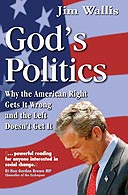
God's Politics, Jim Wallis

"Jim Wallis' book is a scathing indictment of the way that conservative evangelicals in the US have self-righteously attempted to co-opt any discussion of religion and politics. And, while the Right argues that God's way is their way, the Left pursues an unrealistic separation of religious values from morally grounded political leadership. God's Politics offers a clarion call to make America's religious communities and its government more accountable to key values of the prophetic religious tradition - pro-justice, pro-peace, pro-environment, pro-equality, pro-consistent ethic of life and pro-family. These are the values of love and justice, reconciliation, and community at the core of what many people believe, whether Christian or not."


The image on the front cover is misleading, because this isn't a book about George Bush, or religion and faith in politics in the sense of the 'family values' or 'religious right' crusaders. Instead, it's a thoughtful and essential examination of some of the biggest issues in contemporary culture, from war and violence, to political action, to the enviroment, and how Christians should respond.

I must confess to being slightly enraptured by it, because it is overtly Christian and resolutely progressive. Whilst some of the conclusions it reaches are the antithesis of the 'liberal' platform, they are all neatly and comprehensively wrapped in a single core fact; God loves us, and the world, and we should represent that through love and service towards others.

This for me then is the summation of what Christian life is, and the debates and wisdom contained within are challenging and enlightening to me both as a liberal christian and a Christian Liberal. Some of it I disagree with, most of it I find humbling, but none of it can be easily disregarded. For any Christian who wishes to adequately grapple with the demands of faith and politics in the 21st Century this is essential reading.


Also Try:
Shane Claiborne, The Irresistable Revolution
Sojourners, http://sojo.net/


Monday, October 13, 2014

How Not To Be American: Misadventures in the Land of the Free, Tood McEwen

"'This new American uniform - the baseball cap, t-shirt, shorts and trainers (why not a scooter?) is not about looking good. It's about disappearing into a new, unofficial, global army of cultural babies. It says: I eat hamburgers and watch TV and chew gum all day, I want everyone to play my game, You have to be nice to me and if you're not I'm gonna shoot you, I can't understand a word you say… and what is that but American foreign policy?' Todd McEwen left the United States in 1980, but it's still driving him crazy. He worries about cheeseburgers, Cary Grant, Henry David Thoreau, democracy, the Elks Club and Daffy Duck. Join him on his acid-reflux examination of what America has come to be."


I approached this anticipating an American version of the anthropology, or at least quasi-anthropology, of something like Kate Fox or Bill Bryson. It's really, really not, Instead, it's McEwen's own take on an autobiography, closer to a series of essays and thoughts on subjects from Cary Grant's suit to california politics.

At one point there's a surrealist dream sequence piece.

It's hella weird, and the schtick gets old well before it ends, with the roughly 60% that's really good being heavily outweighed by the stuff that really isn't.

And it definitively doesn't explain how not be American.

Also Try:
Bill Bryson, A Walk in the Woods
Kate Fox, Watching the English
Barack Obama, Audacity of Hope

Wednesday, August 6, 2014

Through Darkest America, Neal Barrett Jr.

"Part of the Isaac Asimov Presents series, this provocative novel is set in a world that nuclear war has almost decimated of cities, technology and large animals. To replace farm livestock, the country's sole source of meat is genetically altered humans, without intelligence or speech. A distant civil war out west, its harsh taxes and harsher collectors, force Howie Ryder to flee his family's Tennessee farm. He falls in with outlaw Pardo, who signs on with a big meat drive only to rustle it and playsand preys onboth sides in running guns. Barrett's SF rendering of this latter-day civil war comes complete with a version of slavery, cavalry charges and a young boy representing the country's coming of age. The romantic narrative skillfully moves from a well-told if familiar story of war and the western frontier to areas of ambiguity and uncertainty that readers are left to answer for themselves."


This is, it has to be said, one of the weirdest books I've ever read. Not so much for the contents (which are pedestrian) or the style (which is standard) but for the concept behind creating a post-Apocalyptic America which is near indistinguishable from Civil War era America (right down to an actual civil war) and has very little in the way of actual post-Apocalyptic America.

Billed as a book about one man's journey through an America devastated by nuclear conflict, and with the Isaac Asimov presents handle to boot, I expected there to be a little bit more exploration of 'after the end' style ideas. Instead, the main consequences seem to have been a technological collapse (valid), the complete disappearance of all black people and animals in America (errr) and the emergence of a shell-shocked untermensch of people who are used as livestock and a foodsupply.

The problems with much of the book stem from its synthesis of post-apocalyptic savagery and a frontiersman spirit which only evokes the old west or the war between the states. This leads to some slightly on the nose, and seemingly unintentional, parralels once the business of slave herding comes in, which come across as a little bit too much of a 'what if we just ate all the African-Americans?'

This really is a problem; the main character is taken to see a stuffed 'Nigger' at the local fair, right before we find out that his family's farm rears people to be eaten. They are explicitly stated to be non-human, but clearly once were and are indistinguishable from humans other than there vacant nature. The aforementioned disappearance of all the animals, and also all the black people doesn't help. The main conflict is between the Government in the industrial heartlands and the rebelling South. For anyone with even a passing familiarity with American history this should be ringing alarm bells.

In no way am I intending to suggest that the author is racist, or that this is a racist book, but it certainly has racist imagery and, I'm sure, unintentionally racist themes which make it an uncomfortable read. This doesn't sit well with the rest of the story which is a dark but ultimately shallow story, a version of which was done better by Patrick Ness in The Knife of Never Letting Go.

It fails more as a post-apocalyptic imagining than a story altogether, but there are certainly better novels exploring the same idea. This would almost certainly now be a book aimed at teens, but there so many better novels set after the fall of civilisation for a teen audience that this would barely excite notice.

Also Try:
Patrick Ness, The Knife of Never Letting Go
John Christopher, The Tripods
George R. Stewart, Earth Abides
Cormac McCarthy, The Road
Daniel Woodrell, Winter's Bone

Sunday, February 16, 2014

A Walk in the Woods, Bill Bryson

"The longest continuous footpath in the world, the Appalachian Trail stretches along the East Coast of the United States, from Georgia to Maine, through some of the most arresting and celebrated landscapes in America.

At the age of forty-four, in the company of his friend Stephen Katz (last seen in the bestselling Neither Here nor There), Bill Bryson set off to hike through the vast tangled woods which have been frightening sensible people for three hundred years. Ahead lay almost 2,200 miles of remote mountain wilderness filled with bears, moose, bobcats, rattlesnakes, poisonous plants, disease-bearing tics, the occasional chuckling murderer and - perhaps most alarming of all - people whose favourite pastime is discussing the relative merits of the external-frame backpack.

Facing savage weather, merciless insects, unreliable maps and a fickle companion whose profoundest wish was to go to a motel and watch The X-Files, Bryson gamely struggled through the wilderness to achieve a lifetime's ambition - not to die outdoors."


Before ‘An Idiot Abroad’ ever cemented a vision of English travelling that revolved around an uncomprehending blankness about the achievements and successes of other nations, or a distaste for travelling to places of wonder and awe, Bryson was ALSO moodily assessing the state of the world. Far from the current, tiresomely modern exercise in banality that marks out the works of the ‘Is it just me or is everything shit? Brigade’, Bryson deconstructs the places and people around him, drawing meaning and insight from small towns, the food and the arch-locations he journeys through.

His strength as a travel writer is often the incidental way he writes about travel; part historian and part comedian, his musings frequently resemble nothing less than streams of information – facts, figures and analysis are consumed and reassembled in pithy summations, that impart far more than any travelogue or journey plan alone ever could. Bryson at times resembles nothing less than a polymath; the range of research that went into a book such as A Walk in the Woods is intense, but his down-to-earth writing style, aversion to floridity and general good humour often convinces that these are not just post-journey findings, but simply off the cuff recitals of things he knows.

Bryson is my favourite travel companion, and A Walk in the Woods is more than just my favourite book about travelling. Its evocation of a way of life divorced from the wider world, of men and women who mark time by the miles they’ve walked, and who are consumed by their passion, as well as for the world outside and how much we’ve lost of our place in nature is powerful and compelling. Like all the great writers, filmmakers and artists whose work is touched by a love of ‘The Green’ (to borrow an idea from Swamp Thing) reading his books makes you want to scale a mountain, or explore a forest, to lie in the grasp and allow time to pass by.

Also Try:
Bill Bryson, Notes From a Small Island
Tony Hawks, Round Ireland with a Fridge
Dave Gorman, Dave Gorman’s Googlewhack Adventure!
Nathaniel Philbrick, Mayflower