"The three Great Premises of Idiot America:
· Any theory is valid if it sells books, soaks up ratings, or otherwise moves units
· Anything can be true if someone says it loudly enough
· Fact is that which enough people believe. Truth is determined by how fervently they believe it
Pierce asks how a country founded on intellectual curiosity has somehow deteriorated into a nation of simpletons more apt to vote for an American Idol contestant than a presidential candidate. But his thunderous denunciation is also a secret call to action, as he hopes that somehow, being intelligent will stop being a stigma, and that pinheads will once again be pitied, not celebrated. Erudite and razor-sharp, Idiot America is at once an invigorating history lesson, a cutting cultural critique, and a bullish appeal to our smarter selves."
This is an entertaining, but shallow look at where America's unreasonable distrust of reason has come from. Unfortunately it's a little bit too please with itself and comes across as a caricature of smug liberalism, exhausting the things it actually has to say about 20 pages in and then continuing on for much longer than is really required.
I've got a lot of time for people who want to raise the level of public discourse in the US, who believe that vilifying science and education, raising up the ignorant and creating an atmosphere of debate where there's two sides to every story is ridiculous and damaging but this book is more focused on cheap point scoring and ad hominem attacks, plus a peculiar fascination with the work of James Madison and obscure 19th Century cranks and oddballs.
The root of the problem comes from Pierce's idea that there's something noble and righteous about being slightly unhinged and coming up with crazy iideas. He just thinks they've become too mainstream and America has followed them too far into the wilderness. This misses the point, that education, science and the progression of knowledge invalidate the crank altogether.
Not really worth reading, in the end, but it does have a beautiful cover illustration, and the book itself has the heft and weight of something much better than itself.
Showing posts with label Sort of Non-Fiction. Show all posts
Wednesday, November 19, 2014
Monday, October 13, 2014
America Alone; The End Of The World As We Know It, Mark Steyn
"It's the end of the world as we know it...Someday soon, you might wake up to the call to prayer from a muezzin. Europeans already are. And liberals will still tell you that "diversity is our strength"--while Talibanic enforcers cruise Greenwich Village burning books and barber shops, the Supreme Court decides sharia law doesn't violate the "separation of church and state," and the Hollywood Left decides to give up on gay rights in favor of the much safer charms of polygamy. If you think this can't happen, you haven't been paying attention, as the hilarious, provocative, and brilliant Mark Steyn shows to devastating effect. The future, as Steyn shows, belongs to the fecund and the confident. And the Islamists are both, while the West is looking ever more like the ruins of a civilization. But America can survive, prosper, and defend its freedom only if it continues to believe in itself, in the sturdier virtues of self-reliance (not government), in the centrality of family, and in the conviction that our country really is the world's last best hope."
Mark Steyn's America Alone is the kind of book that I pick up every now and then and read in the same way Southern schools approach creationism and evolution; it's reading the controversy, Frankly, if the above quote doesn't represent it enough, American Alone is a brilliantly though out, well argued and utterly incorrect assertion that Islam is on an unstoppable path to taking over Europe and the world.
There's so much wrong about this that even the stuff that's genuinely interesting and important can be ignored; the work on demographics, and attempt to get beyond the stale arguments between conservative and liberals about Islam to talk about what Islam itself believes is good, but too often if becomes bogged down in reactionary dogma and xenophobic spite.
If you've seen Affleck vs Maher recently, you'll know the thrust of the argument; Islam is a threat not just to conervative ideology but liberal too, there's more of them every year and less of us, and sooner of later their ideas win democratically because they can muster the only voices. It all relies on an us-them attitude, and ignores pretty much anything on progressive or liberal voices within Islam, but it's an argument that seems to be growing in popularity and prominence.
It's worth reading then, if only to be able to refute it, and to quote it in disbelief to incredulous friends.
Also Try:
This American Life: A Not So Simple Majority; http://www.thisamericanlife.org/radio-archives/episode/534/a-not-so-simple-majority
How Not To Be American: Misadventures in the Land of the Free, Tood McEwen
"'This new American uniform - the baseball cap, t-shirt, shorts and trainers (why not a scooter?) is not about looking good. It's about disappearing into a new, unofficial, global army of cultural babies. It says: I eat hamburgers and watch TV and chew gum all day, I want everyone to play my game, You have to be nice to me and if you're not I'm gonna shoot you, I can't understand a word you say… and what is that but American foreign policy?' Todd McEwen left the United States in 1980, but it's still driving him crazy. He worries about cheeseburgers, Cary Grant, Henry David Thoreau, democracy, the Elks Club and Daffy Duck. Join him on his acid-reflux examination of what America has come to be."
I approached this anticipating an American version of the anthropology, or at least quasi-anthropology, of something like Kate Fox or Bill Bryson. It's really, really not, Instead, it's McEwen's own take on an autobiography, closer to a series of essays and thoughts on subjects from Cary Grant's suit to california politics.
At one point there's a surrealist dream sequence piece.
It's hella weird, and the schtick gets old well before it ends, with the roughly 60% that's really good being heavily outweighed by the stuff that really isn't.
And it definitively doesn't explain how not be American.
Also Try:
Bill Bryson, A Walk in the Woods
Kate Fox, Watching the English
Barack Obama, Audacity of Hope
Prime Minister Portillo and other things that never happened, various
"What if Lenin's train had crashed on the way to the Finland Station? Lee Harvey Oswald had missed? Lord Halifax had become Prime Minister in 1940 instead of Churchill? In this diverting and thought-provoking book of counter-factuals a collection of distinguished commentators consider how things might have been."
I find these non-fiction 'What if?' books slightly sad, as they work as neither a truly good history book, or as a work of historical fiction. This is compounded by a mixed bag of authors, who range from those catalogueing slight alterations to full blown changes in the timeline, in a variety of styles, with varying degrees of success.
One of the big issues is that very few of these imagine a world changed all that much by the alterations they describe; most are obscure, or at least historically distant, enough that it's hard to see how a revitalised party or individual could have impacted more. Even greater changes, like JFK surviving or Churchill being passed over for Halifax engender only slight fluctuations - legislation passes slower, or the pace of the war moves differently, with the same fixed outcome.
It's a very Fukuyama-esque book, where the outcome we currently have is seemingly all that's possible. Compare and contrast to real works of speculative history, such as Harry Turtledove, and the difference is huge.
Often dry, sometimes interesting, but only fitfully worth dipping into, this is a book more for the writers than the readers, and is best passed over in favour of better offerings.
Also Try;
Robert Harris, Fatherland
Eric Flint; 1631
Harry Turtledove, Guns of the South
Wednesday, August 6, 2014
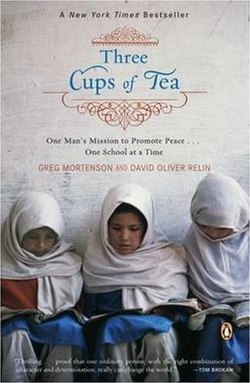
Three Cups of Tea, Greg Mortenson and David Oliver Relin
"'Here we drink three cups of tea to do business; the first you are a stranger, the second you become a friend, and the third, you join our family, and for our family we are prepared to do anything - even die' - Haji Ali, Korphe Village Chief, Karakoram mountains, Pakistan.
In 1993, after a terrifying and disastrous attempt to climb K2, a mountaineer called Greg Mortenson drifted, cold and dehydrated, into an impoverished Pakistan village in the Karakoram Mountains. Moved by the inhabitants' kindness, he promised to return and build a school. "Three Cups of Tea" is the story of that promise and its extraordinary outcome. Over the next decade Mortenson built not just one but fifty-five schools - especially for girls - in remote villages across the forbidding and breathtaking landscape of Pakistan and Afghanistan, just as the Taliban rose to power. His story is at once a riveting adventure and a testament to the power of the humanitarian spirit."
The weirdest thing about Three Cups of Tea is that it's a hugely enjoyable book until you actually go and read further, because it turns out that everything you've read in this, nominally, non-fiction book is ... Broadly untrue? Vaguely inaccurate? A pack of total lies? Whichever version you go for, it kind of undermines the rest of the narrative. That's a shame, because without the critique Mortenson's story is wonderfully inspiring and compelling.
A mountaineer who stumbled across a Pakistani village whilst descending K2 and was bought back to health by the people there, promising to return and build them a school as thanks, Mortenson is an unfailingly interesting person to read. For the first half of the story I was enraptured by his account, and the breathless narration by journalist and self-professed Mortensom disciple Relin. The story is vividly told, including history, political commentary and context aplenty, alongside an engaging story of triumph against the odds in building the first school despite opposition from corrupt and desperate Pakistani's and indifferent Americans.
Unfortunately, I then went online and read some of the commentary to the book, which sets the benevolent charity Mortenson founded within a wider narrative of financial mismanagement, endemic internal corruption and absolutely no willingness to address these issues. Mortenson's slacker background and inability (and unwillingness) to work with 'the man' suddenly becomes less endearing and more a flashing warning sign that he absolutely should not be in charge of a multi-million dollar organisation. Anyone who is almost uncontactable most of the time, ignores official forms and works from his gut in selecting staff (all traits which are presented as utterly positive and vital to the success of his mission) are obviously going to become liabilities when millions of dollars disappears with no paper trail or inclination to follow up on where it went.
All of which leaves a sour taste in the mouth even before you discover that the two most electrifying moments in the book; Mortenson's near death on K2 (and subsequent arrival in that first impoverished village) and his kidnap and detention by militants in Pakistan's badlands are utterly false and never took place.
From then on the remainder of the book is somewhat less readable as an accurate account of one mans war on poverty and lack of education.
So, worth a read for a look at international development on a budget, but not an organisation to donate to, and certainly not an example to follow.
Also Try:
Jon Krakauer, http://www.thedailybeast.com/articles/2013/04/08/is-it-time-to-forgive-greg-mortenson.html
Jon Krakauer, Three Cups of Deceit
Joel Connely, http://www.seattlepi.com/default/article/Greg-Mortenson-Three-Cups-of-Me-1356850.php
Also Try:
Jon Krakauer, http://www.thedailybeast.com/articles/2013/04/08/is-it-time-to-forgive-greg-mortenson.html
Jon Krakauer, Three Cups of Deceit
Joel Connely, http://www.seattlepi.com/default/article/Greg-Mortenson-Three-Cups-of-Me-1356850.php
Subscribe to:
Posts (Atom)